
hrishivish23/giorom-3d-t-plasticine-3d
📌 PhysicsEngine: Reduced-Order Neural Operators for Lagrangian Dynamics
By [Hrishikesh Viswanath](https://huggingface.co/hrishivish23), Yue Chang, Julius Berner, Peter Yichen Chen, Aniket Bera
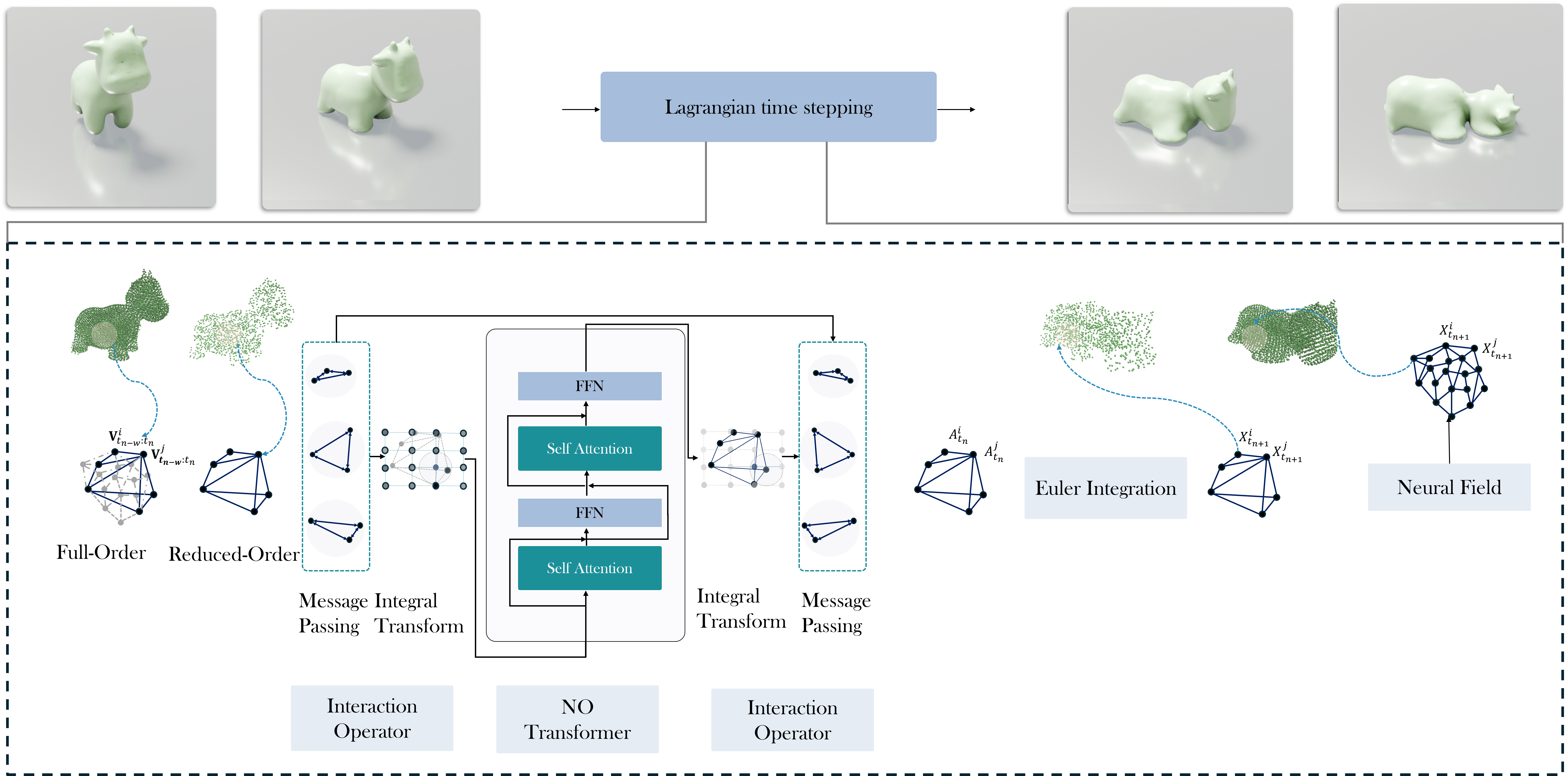
📝 Model Overview
GIOROM is a Reduced-Order Neural Operator Transformer designed for Lagrangian dynamics simulations on highly sparse graphs. The model enables hybrid Eulerian-Lagrangian learning by:
- Projecting Lagrangian inputs onto uniform grids with a Graph-Interaction-Operator.
- Predicting acceleration from sparse velocity inputs using past time windows with a Neural Operator Transformer.
- Learning physics from sparse inputs (n ≪ N) while allowing reconstruction at arbitrarily dense resolutions via an Integral Transform Model.
- Dataset Compatibility: This model is compatible with `MPM-Verse-MaterialSim-Small/Plasticine3DNCLAWSmall`,
⚠ Note: While the model can infer using an integral transform, this repository only provides weights for the time-stepper model that predicts acceleration.
📊 Available Model Variants
Each variant corresponds to a specific dataset, showcasing the reduction in particle count (n: reduced-order, N: full-order).
💡 How It Works
🔹 Input Representation
The model predicts acceleration from past velocity inputs:
- Input Shape:
[n, D, W] n: Number of particles (reduced-order, n ≪ N)D: Dimension (2D or 3D)W: Time window (past velocity states)
- Projected to a uniform latent space of size
[c^D, D]where: c ∈ {8, 16, 32}n - δn ≤ c^D ≤ n + δn
This allows the model to generalize physics across different resolutions and discretizations.
🔹 Prediction & Reconstruction
- The model learns physical dynamics on the sparse input representation.
- The integral transform model reconstructs dense outputs at arbitrary resolutions (not included in this repo).
- Enables highly efficient, scalable simulations without requiring full-resolution training.
🚀 Usage Guide
1️⃣ Install Dependencies
pip install transformers huggingface_hub torchgit clone https://github.com/HrishikeshVish/GIOROM/
cd GIOROM2️⃣ Load a Model
from models.giorom3d_T import PhysicsEngine
from models.config import TimeStepperConfig

time_stepper_config = TimeStepperConfig()

simulator = PhysicsEngine(time_stepper_config)
repo_id = "hrishivish23/giorom-3d-t-sand3d"
time_stepper_config = time_stepper_config.from_pretrained(repo_id)
simulator = simulator.from_pretrained(repo_id, config=time_stepper_config)
3️⃣ Run Inference
import torch
📂 Model Weights and Checkpoints
📚 Training Details
🔧 Hyperparameters
- Graph Interaction Operator layers: 4
- Transformer Heads: 4
- Embedding Dimension: 128
- Latent Grid Sizes:
{8×8, 16×16, 32×32} - Learning Rate:
1e-4 - Optimizer:
Adamax - Loss Function:
MSE + Physics Regularization (Loss computed on Euler integrated outputs) - Training Steps:
1M+ steps
🖥️ Hardware
- Trained on: NVIDIA RTX 3050
- Batch Size:
2
📜 Citation
If you use this model, please cite:
@article{viswanath2024reduced,
  title={Reduced-Order Neural Operators: Learning Lagrangian Dynamics on Highly Sparse Graphs},
  author={Viswanath, Hrishikesh and Chang, Yue and Berner, Julius and Chen, Peter Yichen and Bera, Aniket},
  journal={arXiv preprint arXiv:2407.03925},
  year={2024}
}
💬 Contact
For questions or collaborations:
- 🧑💻 Author: Hrishikesh Viswanath
- 📧 Email: hviswan@purdue.edu
- 💬 Hugging Face Discussion: Model Page
🔗 Related Work
- Neural Operators for PDEs: Fourier Neural Operators, Graph Neural Operators
- Lagrangian Methods: Material Point Methods, SPH, NCLAW, CROM, LiCROM
- Physics-Based ML: PINNs, GNS, MeshGraphNet
🔹 Summary
This model is ideal for fast and scalable physics simulations where full-resolution computation is infeasible. The reduced-order approach allows efficient learning on sparse inputs, with the ability to reconstruct dense outputs using an integral transform model (not included in this repo).