
braindecode/REVE
0
REVE
R\ epresentation for E\ EG with V\ ersatile E\ mbeddings (REVE) from El Ouahidi et al. (2025) [reve].
Architecture-only repository. Documents the braindecode.models.REVE class. No pretrained weights are distributed here. Instantiate the model and train it on your own data.Quick start
pip install braindecodefrom braindecode.models import REVE
model = REVE(
n_chans=22,
sfreq=250,
input_window_seconds=4.0,
n_outputs=4,
)The signal-shape arguments above are illustrative defaults — adjust to match your recording.
Documentation
- Full API reference: <https://braindecode.org/stable/generated/braindecode.models.REVE.html>
- Interactive browser (live instantiation, parameter counts): <https://huggingface.co/spaces/braindecode/model-explorer>
- Source on GitHub: <https://github.com/braindecode/braindecode/blob/master/braindecode/models/reve.py#L35>
Architecture
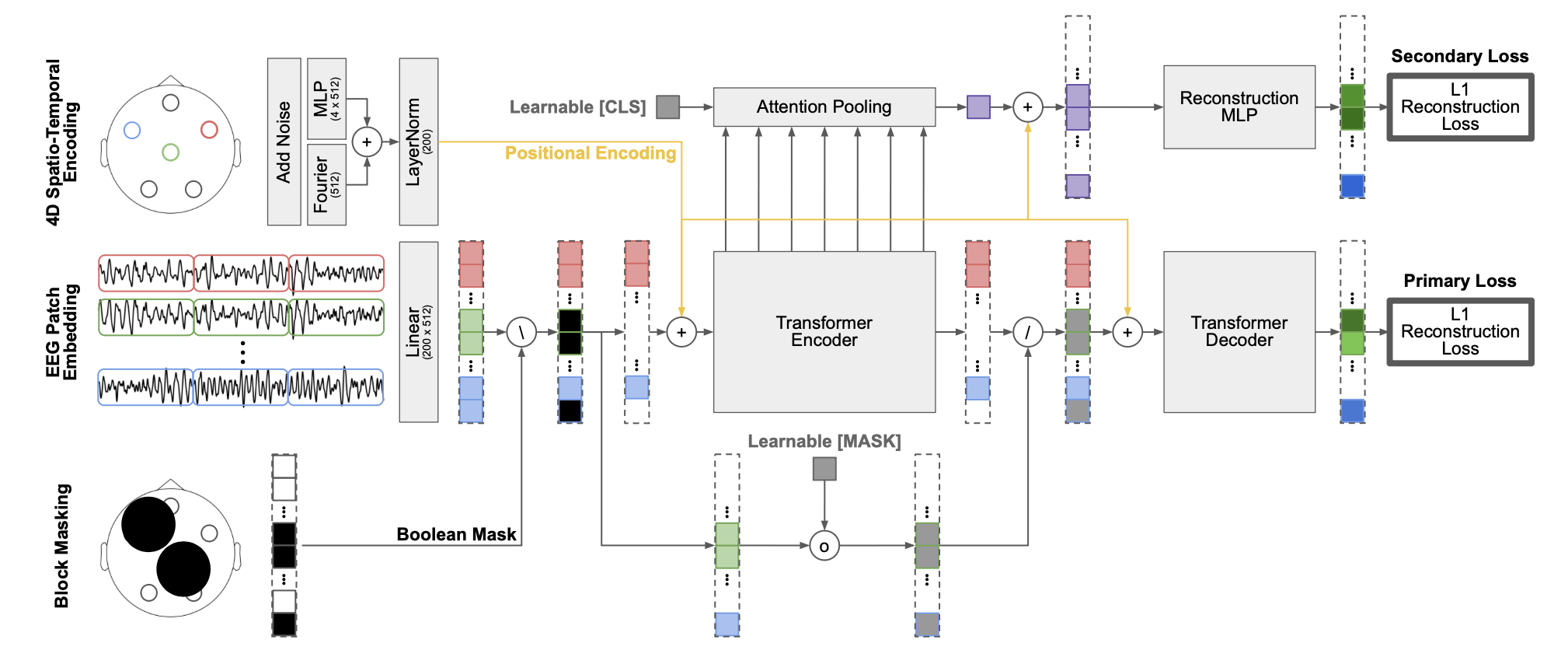
Parameters
References
- El Ouahidi, Y., Lys, J., Thölke, P., Farrugia, N., Pasdeloup, B., Gripon, V., Jerbi, K. & Lioi, G. (2025). REVE: A Foundation Model for EEG - Adapting to Any Setup with Large-Scale Pretraining on 25,000 Subjects. The Thirty-Ninth Annual Conference on Neural Information Processing Systems. https://openreview.net/forum?id=ZeFMtRBy4Z
- Défossez, A., Caucheteux, C., Rapin, J., Kabeli, O., & King, J. R. (2023). Decoding speech perception from non-invasive brain recordings. Nature Machine Intelligence, 5(10), 1097-1107.
Citation
Cite the original architecture paper (see References above) and braindecode:
@article{aristimunha2025braindecode,
  title   = {Braindecode: a deep learning library for raw electrophysiological data},
  author  = {Aristimunha, Bruno and others},
  journal = {Zenodo},
  year    = {2025},
  doi     = {10.5281/zenodo.17699192},
}
License
BSD-3-Clause for the model code (matching braindecode). Pretraining-derived weights, if you fine-tune from a checkpoint, inherit the licence of that checkpoint and its training corpus.