
ai-babai/gigaam-multilingual-mlx
GigaAM-Multilingual MLX FP16
Native offline speech recognition and audio transcription for Russian, Kazakh, Kyrgyz, and Uzbek on Apple Silicon with MLX. Core speech-to-text languages: Russian (русский), Kazakh (қазақша), Kyrgyz (кыргызча), and Uzbek (o‘zbekcha).
This independent port is based on the official GigaAM repository and GigaAM-Multilingual source model.
This repository contains the float16 reference artifact. Choose FP16 for the fastest measured five-minute run and reference-port fidelity.
GitHub · PyPI · All variants · Full benchmark
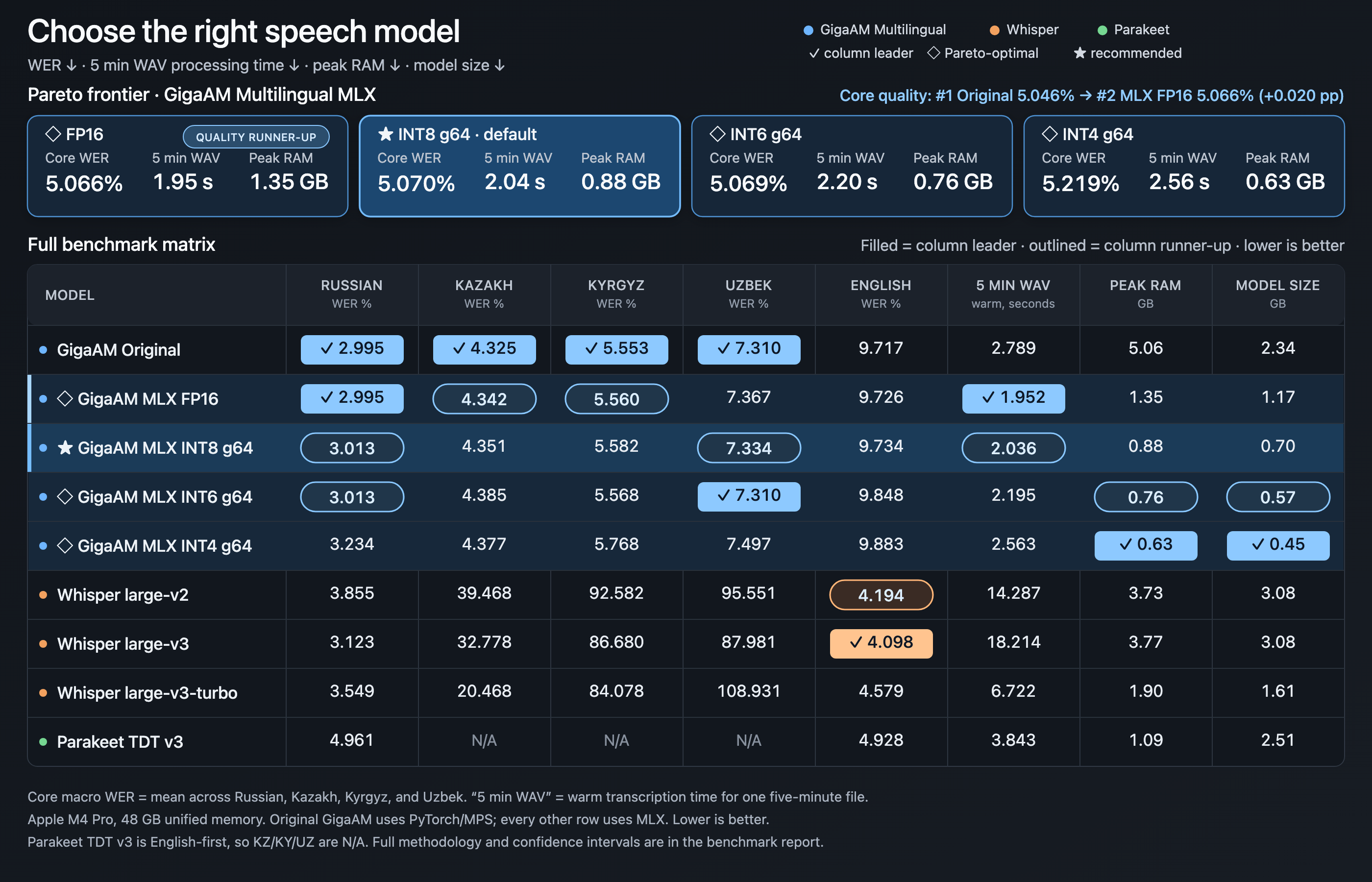
Filled pills mark column leaders, outlined pills mark column runners-up, ◇ the Pareto frontier, and ★ the recommended default. Lower is better.
Quick start
Requires Apple Silicon, macOS 14+, Python 3.12 or 3.13, and ffmpeg.
brew install uv ffmpeg
uv tool install gigaam-multilingual-mlx==0.2.0
gigaam-stt audio.wav --variant fp16 --output transcript.txt
For a Python project use uv add gigaam-multilingual-mlx==0.2.0. The runtime downloads the immutable model-weight revision v0.1.0 once and reuses the standard Hugging Face cache.
Artifact
- Hub revision:
v0.1.0 - Source revision:
3905cd51c3ed4e88c8edf33f3302969ba480a327 - Model size:
model.safetensors— 1.17 GB - Weights SHA-256:
d6d7bcef5e1b77700c84d669635a88021724fd3b1ae0c408890bccdf3c8d2269 - Config SHA-256:
72c544eec78996dc57ed88f8308d735647644e981ec81f46ce945ee1b027a174 - Runtime compatibility:
gigaam-multilingual-mlx>=0.1.0,<0.3.0,mlx>=0.32,<0.33
manifest.json records source and parent revisions, hashes, conversion metadata, quantization rules, strict-load validation, and compatibility without machine-local paths.
Benchmark highlights
- Original GigaAM ranks first at 5.046% core macro WER; MLX FP16 ranks second at 5.066%, a difference of only +0.020 percentage points.
- INT8 reached 3.013% Russian WER and 4.351% / 5.582% / 7.334% WER on Kazakh, Kyrgyz, and Uzbek in the pinned public FLEURS selections.
- On one Russian five-minute WAV, INT8 was 3.30× faster than Whisper v3 Turbo, 7.02× faster than large-v2, and 8.94× faster than large-v3.
- Whisper and Parakeet were better on the English appendix. Results come from one 14-inch MacBook Pro with Apple M4 Pro and 48 GB memory.
See the full reproducible report for all nine compared models, per-language WER/CER, paired-bootstrap confidence intervals, commands, hashes, and limitations.
Local transcription server
Version 0.2.0 adds an optional OpenAI-compatible transcription endpoint:
uv tool install 'gigaam-multilingual-mlx[server]==0.2.0'
gigaam-stt serve --variant fp16
See the server guide for curl and Python examples, network access, and limitations. whisper-1 is a compatibility alias; inference still uses GigaAM Multilingual MLX.
Intended use and limitations
Intended for local, offline automatic speech recognition in Russian, English, Kazakh, Kyrgyz, and Uzbek on Apple Silicon. It is not a diarization system, realtime streaming service, forced aligner, or cloud service. Word timestamps are approximate greedy-CTC frame timings. Accuracy can degrade with noise, far-field speech, accents, code-switching, music, overlapping speakers, or domains unlike the public evaluation subsets.
Only Apple M4 Pro was benchmarked for this release. M1-M5 machines are expected to be runtime-compatible within the documented macOS/MLX range, but they are not claimed to have the same speed or memory figures.
License and provenance
The MLX port and converted artifacts are released under MIT, matching the upstream license. See `LICENSE` and `THIRD_PARTY_NOTICES.md`. The exact upstream repository is https://github.com/salute-developers/GigaAM; the source model card is https://huggingface.co/ai-sage/GigaAM-Multilingual.
Citation
Please cite both this MLX software release and the original GigaAM-Multilingual work:
@software{popkov2026gigaammlx,
  author = {Maksim Popkov},
  title = {GigaAM-Multilingual MLX},
  year = {2026},
  version = {0.2.0},
  url = {https://github.com/ai-babai/gigaam-multilingual-mlx}
}

@misc{gigaam_multilingual,
  title = {GigaAM Multilingual: Foundation Model for Underrepresented Languages},
  author = {Andrei Kuzmenko and Alexandr Maximenko and Aleksandr Kutsakov and Georgii Gospodinov and Dmitrii Bolotov and Oleg Kutuzov and Pavel Bogomolov and Fyodor Minkin},
  year = {2026},
  eprint = {2607.10371},
  archivePrefix = {arXiv},
  primaryClass = {eess.AS},
  url = {https://arxiv.org/abs/2607.10371}
}