
blambert/ne_plant_classes
NE Plant Classes Plant photographs from the iNaturalist open data archive, filtered to a New England bounding box (latitude 41 to 48, longitude -74 to -67) and each labelled by a vision language model with the kind of subject it depicts. Labels come from Qwen/Qwen3.5-9B; they are model output, not human annotation, and have not been checked against a hand-labelled sample. 151,945 images in a single train split. Columns image - the photograph, embedded in the… See the full description on the dataset page: https://huggingface.co/datasets/blambert/ne_plant_classes.
NE Plant Classes
Plant photographs from the iNaturalist open data archive, filtered to a New England bounding box (latitude 41 to 48, longitude -74 to -67) and each labelled by a vision language model with the kind of subject it depicts.
Labels come from Qwen/Qwen3.5-9B; they are model output, not human annotation, and have not been checked against a hand-labelled sample.
151,945 images in a single train split.
Columns
image- the photograph, embedded in the datasetoutput- the model's one-word classificationfile_name- the original image filename, named after the iNaturalist photo id
Labels
The prompt sorts each photo into one of five classes, falling back to other when none of the first four fit.
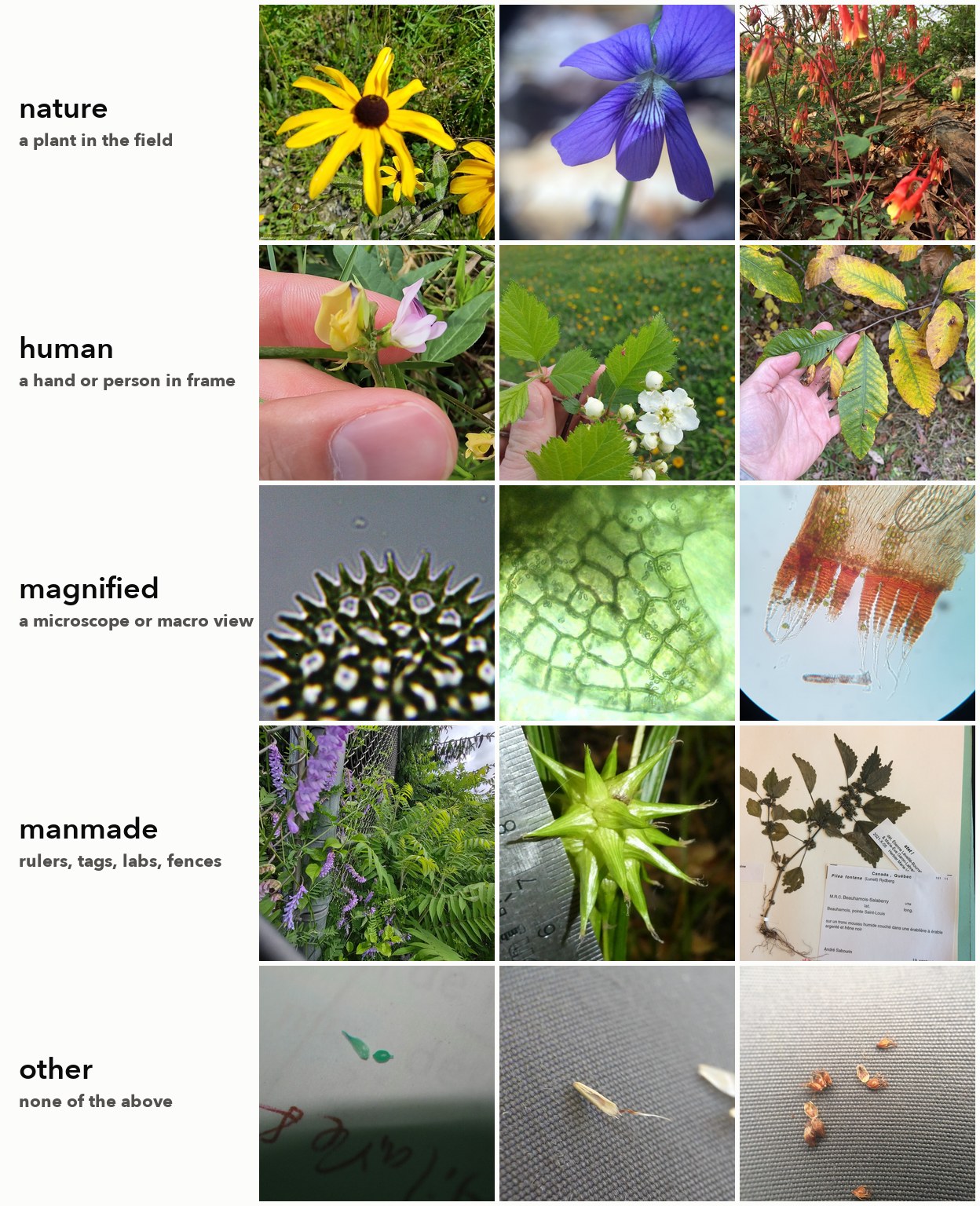
Label Quality
The labels are model output and some of them are wrong. A ViT classifier trained on this dataset (blambert/ne_plant_classes_vit) disagrees with the label on 1.6% of held-out photos, and a review of 160 of those disagreements suggested the label, not the classifier, was wrong about two thirds of the time. That puts roughly 1% of the dataset, on the order of 1,500 photos, under a wrong label, and that is a lower bound: the classifier learned the labeller's habits, so mistakes the two share are invisible to it.
The errors are concentrated:
manmade is the least reliable label, partly because the prompt never settled what it means: a plant growing in a sidewalk crack or beside a road is sometimes manmade and sometimes nature.
This is still good enough for some purposes. Separating nature from human is reliable enough for coarse filtering, which is what blambert/ne_plant_photos does. Treat the small classes, and any per-label accuracy measured against these labels, with more caution, and hand-label a sample before trusting them as ground truth.
Licensing
The photographs keep whichever license each iNaturalist observer chose, so the collection is not under a single license and most of it is non-commercial.
Everything but the CC0 portion requires attribution. Observer and photo metadata live in the iNaturalist open data archive, joinable on the photo id in file_name. The sample photos on this card are all CC0.
Provenance
Labelled by running vlm process with prompts/inat_classify.txt over the downloaded images, then uploaded with vlm upload-dataset. Both commands come from the vlm-toolkit repo; the filtering and download steps are in plant-pics.