
UniDataPro/hair-loss-male-norwood-scale
Male Hair Loss Dataset - 2 400+ images Dataset comprises 2,400+ photos of male alopecia (hair loss) captured from 5 angles, meticulously labeled into 7 classes according to the Norwood-Hamilton scale. It is designed for machine learning and deep learning applications, particularly in diagnosing hair disorders, evaluating scalp health, and personalizing hair restoration treatments. By utilizing this dataset, researchers and dermatologists can enhance hair loss analysis, improve… See the full description on the dataset page: https://huggingface.co/datasets/UniDataPro/hair-loss-male-norwood-scale.
Male Hair Loss Dataset - 2 400+ images
Dataset comprises 2,400+ photos of male alopecia (hair loss) captured from 5 angles, meticulously labeled into 7 classes according to the Norwood-Hamilton scale. It is designed for machine learning and deep learning applications, particularly in diagnosing hair disorders, evaluating scalp health, and personalizing hair restoration treatments.
By utilizing this dataset, researchers and dermatologists can enhance hair loss analysis, improve diagnostic accuracy, and develop advanced learning models for early detection of baldness patterns. - [Get the data](https://unidata.pro/datasets/male-hair-loss-dataset/?utm_source=huggingface-med&utm_medium=referral&utm_campaign=hair-loss-male-norwood-scale)
The dataset includes high-quality scalp images with varying hair density, follicle visibility, and skin types.
Frequently Asked Questions
How does the Norwood-Hamilton scale support model development?
The dataset uses seven classes based on the Norwood-Hamilton scale, providing an ordinal representation of male pattern hair loss progression. This makes the data useful not only for conventional multi-class classification but also for experiments involving ordinal learning, where confusing neighboring stages may be less significant than predicting a substantially different stage. Researchers can investigate whether models learn progressive visual patterns associated with increasing hair loss. The scale can also support evaluation methods that consider the distance between predicted and actual stages rather than treating every classification error as equally severe.
Why are multiple views important for hair loss analysis?
Each person is represented by five complementary views: a full-face photograph, top view, back of the head, left side, and right side. This multi-view structure allows researchers to examine hair loss patterns that may not be visible from a single angle.
What image and annotation formats are provided?
The photographs are supplied in PNG and JPEG formats, while the labeling information is provided in TXT files. These widely supported formats allow researchers to integrate the dataset into conventional computer vision preprocessing and training workflows.
💵 Buy the Dataset: This is a limited preview of the data. To access the full dataset, please contact us at https://unidata.pro to discuss your requirements and pricing options.
Example of the data
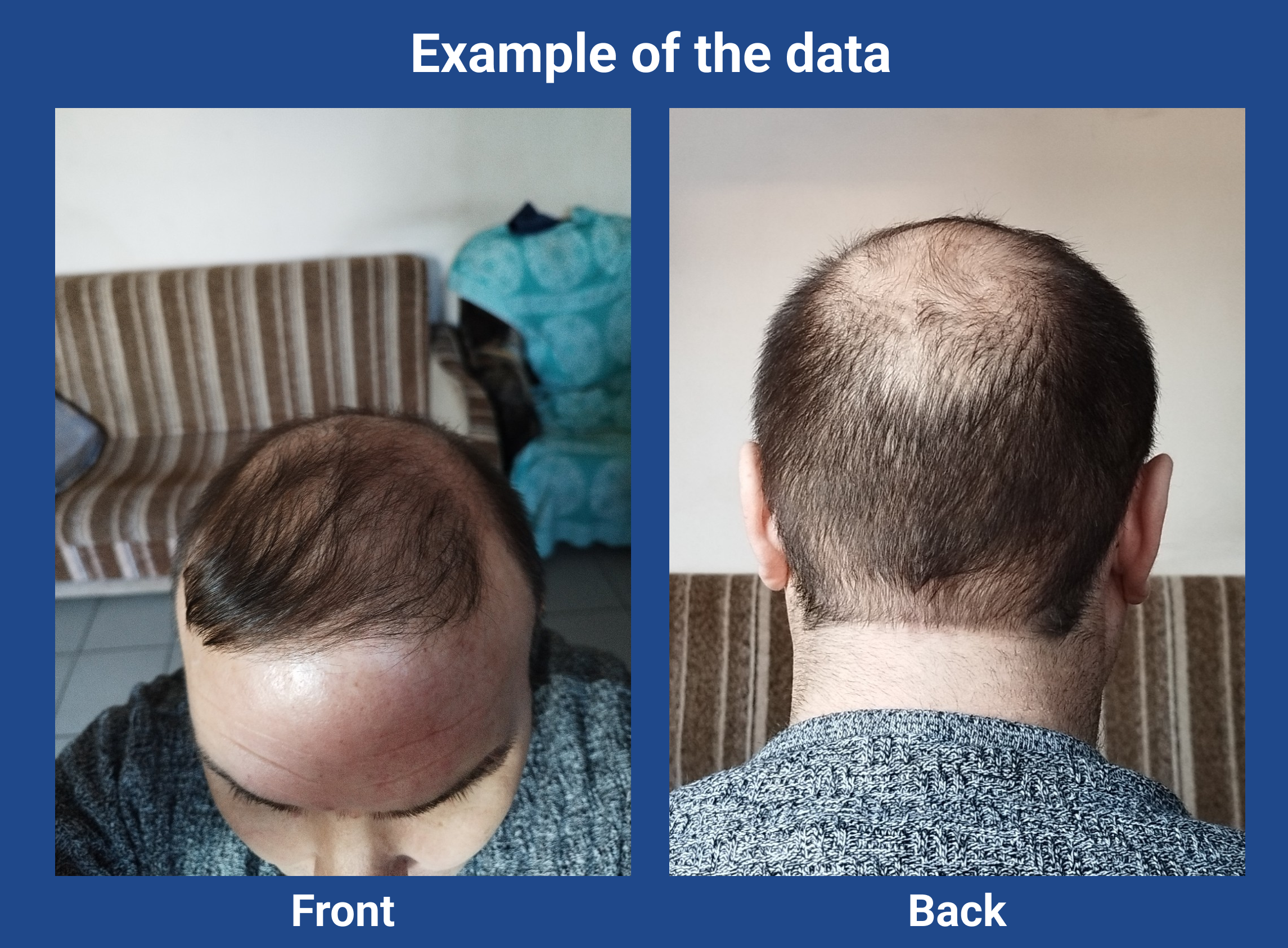 This dataset serves as a critical resource for advancing hair loss treatments, neural networks in dermatology, and AI-powered diagnostic tools with the highest precision.