
DivyanshuSingh96/aimi-anime-rag-dataset-sample
🎌 Ultimate Anime Dataset (8,248 Entries) | 1917-2025 A meticulously curated collection spanning 108 years of anime history Love this dataset and the Anime Receipts concept? You can download the complete project via the links below: 🚀 Unlock the Full Potential Product What You Get Get It Here Tier 1 8,248 Anime Dataset (Parquet) Tier 2 Full AiMi Recommendation System (Backend + UI) Tier 3 Ultimate AiMi Recommendation System + AiMi… See the full description on the dataset page: https://huggingface.co/datasets/DivyanshuSingh96/aimi-anime-rag-dataset-sample.
🎌 Ultimate Anime Dataset (8,248 Entries) | 1917-2025
A meticulously curated collection spanning 108 years of anime history
Love this dataset and the Anime Receipts concept? You can download the complete project via the links below:
🚀 Unlock the Full Potential
This dataset represents 8,248 carefully curated anime entries from 1917 to October 2025, designed for machine learning, data analysis, and creative applications. Each entry contains rich metadata perfect for building recommendation systems, conducting research, or creating unique anime-related projects.
What makes this special:
- ✨ Most current available - Updated through October 2025
- 🎯 RAG-optimized - Special fields designed for semantic search
- 🧹 Production-ready - Cleaned, validated, no duplicates
- 📊 Comprehensive - 25+ metadata fields per anime
- 🌍 108 years of anime history in one place
🗂️ Dataset Structure
File Overview
📁 anime-dataset/
├── 📄 anime_dataset_small_nomic.parquet          # Free sample (500 entries)
└── 📄 premium                           # Directory containing Viral Anime Receipts Sample
Dataset Statistics
- Total Entries: 8,248 anime (full version)
- Sample Provided: 500 anime (this dataset)
- Time Span: 1917 - 2025 (108 years)
- Fields: 25+ metadata columns
- Format: PARQUET (UTF-8 encoded)
- Size: ~832KB (sample), ~20.4MB (full)
📊 Column Descriptions
Core Identification
Content Information
Classification
Episode & Duration Data
Staff Information
...and more...
Visual Assets
🎯 Special Feature: RAG-Optimized Field
What is canonical_embedding_text?
This dataset includes a custom-engineered semantic field specifically optimized for modern Retrieval-Augmented Generation (RAG) systems, vector databases, and embedding models.
Instead of raw columns, this field contains:
✨ A carefully blended, context-rich representation of each anime entry, built from multiple metadata sources and structured for maximum semantic clarity.
Why this field is special
- Embedding-ready out of the box - no preprocessing required
- Built using a proprietary formatting pipeline used in AiMi (愛視) Recommendation System
- Balances plot, characterization, genre cues, and contextual metadata
- Consistent across all 8,248+ anime entries
- Significantly boosts similarity accuracy compared to plain synopsis or tags
🛠️ How to Create RAG Embeddings
While the commercial version of AiMi includes a pre-engineered canonical_embedding_text field (optimized via a proprietary 12-step prompt pipeline), you can easily build your own high-quality embedding context using the metadata provided in this sample.
To get excellent results with models like Nomic v1.5 or OpenAI text-embedding-3, I recommend concatenating the core metadata columns into a structured string.
Python Example:
# 1. Create a rich context string for each anime
# This combines the Title, Visual Description, and Semantic Tags
df['rag_context'] = (
    "Title: " + df['Main Title'] + " | " +
    "Studio: " + df['Animation Work'].fillna('Unknown') + " | " +
    "Tags: " + df['processed_tags'].fillna('') + " | " +
    "Synopsis: " + df['Synopsis'].fillna('')
)

# 2. Inspect the result
print(df['rag_context'].iloc[0])
# Output: "Title: Attack on Titan | Studio: Wit Studio | Tags: action, military... | Synopsis: Humanity lives..."

# 3. Pass this new column to your embedding model!
embeddings = model.encode(df['rag_context'].tolist())
Use Cases
canonical_embedding_text allows you to:
- Build a semantic anime search engine
- Create embeddings directly with your preferred model
- Construct vector databases (FAISS, hnswlib, Pinecone, Weaviate, ChromaDB)
- Train retrieval or recommendation systems
- Experiment with natural language–based similarity querying
And all of this is possible without knowing the internal data fusion method.
💡 Creative Applications
1. 🎟️ Anime Receipt Generator (Trending Idea!)
Create beautiful two-sided anime "receipts" like movie tickets - a viral social media trend!
Front Side (Receipts): <div style="display: flex; justify-content: space-between; width: 400px; height: auto"> <img src="https://www.googleapis.com/download/storage/v1/b/kaggle-user-content/o/inbox%2F9519298%2F440af3793e730c256052ff5bdd9ea9fb%2Fpremiumfront6459.png?generation=1763753700182787&alt=media" style="width: 400px; height: 700px"> <img src="https://www.googleapis.com/download/storage/v1/b/kaggle-user-content/o/inbox%2F9519298%2Fe28bb2454587b36a59287483e3be071e%2Fpremiumfront7074.png?generation=1763753863557484&alt=media" style="width: 400px; height: 700px"> </div>
Back Side (Receipts):
<div style="display: flex; justify-content: space-between; width: 400px; height: auto"> <img src="https://www.googleapis.com/download/storage/v1/b/kaggle-user-content/o/inbox%2F9519298%2Ff2e4e54711fbe4c14e6854fc6f731e40%2Fpremiumback64591.png?generation=1763753818703885&alt=media" style="width: 400px; height: 700px"> <img src="https://www.googleapis.com/download/storage/v1/b/kaggle-user-content/o/inbox%2F9519298%2F9a9b9c98294a50d942ae50e759713593%2Fpremiumback70741.png?generation=1763753886123650&alt=media" style="width: 400px; height: 700px"> </div>
Implementation tip: Use Python's PIL/Pillow or web canvas to generate these programmatically. Perfect for a viral Twitter bot or Instagram account!
2. 🤖 AI-Powered Recommendation System
Build semantic search using RAG (Retrieval-Augmented Generation):
Natural language queries:
- "Anime about friendship that explores deep philosophical themes"
- "Dark fantasy with tragic character arcs and moral ambiguity"
- "Slice of life comedy set in high school with healing atmosphere"
Technology stack:
- Embedding models: Sentence-BERT, Nomic, OpenAI embeddings
- Vector database: FAISS, Pinecone, Weaviate, ChromaDB
- Similarity search: Cosine similarity on 768D/1536D vectors
Why this dataset is perfect:
- Pre-formatted
canonical_embedding_textfield - Rich semantic information (synopsis + tags + themes...)
- Large corpus (8,248 entries) for quality recommendations
3. 📊 Data Analysis & Visualization
Explore anime industry trends:
Temporal Analysis:
- Genre popularity over decades (1980s vs 2020s)
- Studio dominance across eras
- Rating distribution evolution
Content Analysis:
- Most common themes/tags
- Correlation between studio and rating
- Episode count trends (12-ep vs 24-ep seasons)
NLP Projects:
- Synopsis sentiment analysis
- Genre classification using ML
- Trend prediction models
4. 🎮 Interactive Applications
Build:
- Anime discovery web apps
- Personalized watchlist generators
- Comparison tools (studio vs studio, genre vs genre)
- Trivia/quiz games using metadata
- Social sharing platforms
APIs you can create:
- Search by natural language
- Filter by year/rating/type/studio
- "Find similar" based on any anime
- Random anime picker with filters
5. 🎓 Educational Projects
Perfect for:
- Machine learning portfolio projects
- Data science bootcamp capstones
- NLP and embedding experiments
- University thesis/research papers
- Teaching RAG concepts
What you'll learn:
- Vector embeddings and semantic search
- Data cleaning and preprocessing
- Building recommendation systems
- API development
- Full-stack ML applications
🛠️ Example Usage
Quick Start: Load the Data
import pandas as pd

# Load sample dataset
df = pd.read_csv('anime_sample_500.parquet')

# Basic exploration
print(f"Total anime: {len(df)}")
print(f"Columns: {df.columns.tolist()}")
print(f"Date range: {df['filter_year'].min()} - {df['filter_year'].max()}")

# View a sample entry
df.iloc[0][['Main Title', 'synopsis', 'Max Rating']]
Example 1: Simple Filtering
# Find highly-rated modern anime
modern_classics = df[
    (df['filter_year'] >= 2015) &
    (df['Max Rating'] >= 8.0)
]

print(f"Found {len(modern_classics)} highly-rated modern anime")
Example 2: Text Analysis
from collections import Counter

# Most common tags
all_tags = []
for tags in df['processed_tags'].dropna():
    all_tags.extend([t.strip() for t in tags.split(',')])

top_10_tags = Counter(all_tags).most_common(10)
print("Most common anime themes:")
for tag, count in top_10_tags:
    print(f"  {tag}: {count}")
Example 3: Building Embeddings (RAG)
from sentence_transformers import SentenceTransformer

# Load embedding model
model = SentenceTransformer('nomic-ai--nomic-embed-text-v1.5')

# Use the RAG-optimized field
# Build your own embedding text from descriptive columns
# Example: df['canonical_embedding_text'] = df['Main Title'] + " " + df['Synopsis']
embedding_texts = df['canonical_embedding_text'].tolist()

# Generate embeddings
embeddings = model.encode(embedding_texts, show_progress_bar=True)

print(f"Generated {len(embeddings)} embeddings of dimension {embeddings.shape[1]}")
Example 4: Semantic Search
import numpy as np
from sklearn.metrics.pairwise import cosine_similarity

# User query
query = "dark fantasy anime with strong female protagonist"
query_embedding = model.encode([query])

# Find most similar anime
similarities = cosine_similarity(query_embedding, embeddings)[0]
top_indices = np.argsort(similarities)[-10:][::-1]

print("Top 10 recommendations:")
for idx in top_indices:
    print(f"  {df.iloc[idx]['Main Title']} (similarity: {similarities[idx]:.2f})")
📈 Data Quality & Preprocessing
What's Been Done
- ✅ Duplicates removed - Each anime appears once
- ✅ Consistent formatting - Standardized column names and values
- ✅ Validated entries - Removed incomplete or corrupted data
- ✅ Normalized ratings - 0-10 scale across all entries
- ✅ Unicode handling - Japanese characters properly encoded
- ✅ Missing value handling - Clearly marked as NULL/NaN
What You Might Need to Do
- Filter by specific years/types/ratings for your use case
- Handle missing values according to your requirements
- Generate embeddings if using RAG/semantic search
- Create additional derived features (decade, era, etc.)
🎨 Sample Projects You Can Build
Beginner Level
- Simple Search Interface - Filter by year, rating, type
- Random Anime Picker - With customizable filters
- Stats Dashboard - Visualize trends using Matplotlib/Plotly
- Tag Cloud Generator - Most popular themes/genres
Intermediate Level
- Content-Based Recommender - Using TF-IDF on synopsis
- Anime Receipt Generator - Viral social media content
- Studio Comparison Tool - Analyze studio performance
- Genre Classifier - ML model to predict genres from synopsis
Advanced Level
- RAG-Powered Search Engine - Natural language queries
- Full-Stack Web App - FastAPI backend + React/Streamlit frontend
- Personalized Recommender - Using collaborative filtering
- Trend Prediction Model - Forecast next year's popular genres
🚀 Want the Complete Experience?
This sample dataset (500 anime) is perfect for learning and experimentation.
Full Dataset Includes:
- 📊 All 8,248 anime entries (1917-2025)
- 🖼️ 8,248 high-quality poster, logo and backdrop images
- 🤖 Pre-built FAISS index for instant semantic search
- 📚 Additional metadata fields
- 🎨 Complete documentation
Production-Ready RAG System Available
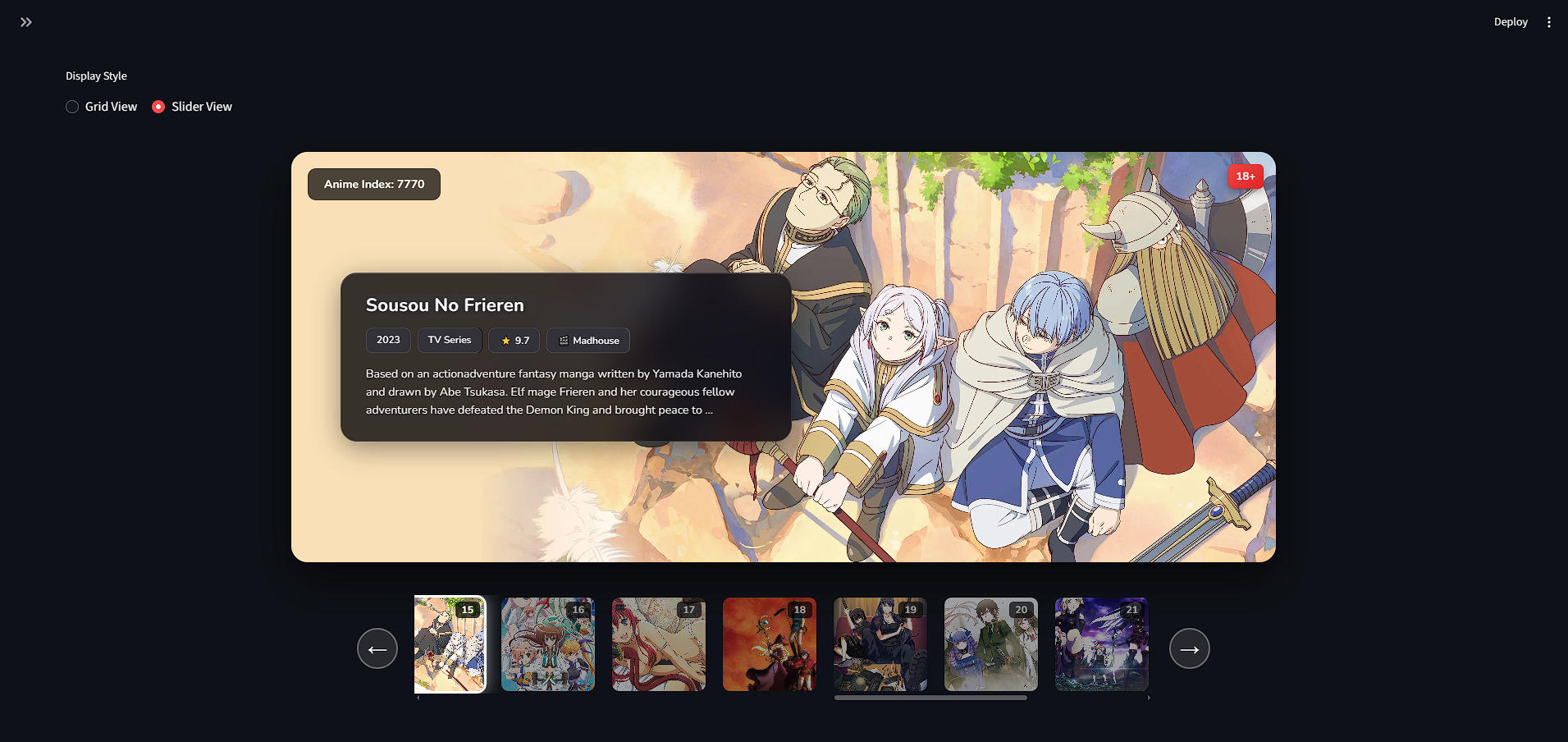
If you want to skip the implementation and get a fully functional anime recommendation system with beautiful UI, I've built a complete application:
Features:
- ⚡ FastAPI backend with semantic search
- 🎨 Streamlit frontend with Apple-inspired design
- 🧠 RAG pipeline using Nomic v1.5 embeddings
- 🔍 Natural language queries ("dark fantasy with strong female lead")
- 🎲 Similarity search (find anime like X)
- 📊 Dynamic filters (year, rating, type)
- 💾 Smart caching for instant responses
Screenshots Preview:

🎯 Common Use Cases by Field
🤝 Contributing & Feedback
Found an error? Open an issue on the dataset page. Built something cool? Share it in the comments - I'd love to see what you create! Have questions? Comment below and the community can help.
📜 License & Usage
✅ What You CAN Do (Make Money):
- Build a SaaS: Deploy a recommendation site/app and charge users.
- Freelance: Build projects for clients (deploy the app for them).
- Sell Outputs: Sell the receipts, API access, or recommendations.
- White-label: Remove AiMi branding and use your own logos.
- Deploy: Host on any server (AWS, Vercel, DigitalOcean).
❌ What You CANNOT Do (Piracy):
- Resell the Code: You cannot sell the raw source code/zip file itself.
- Open Source: You cannot upload the code to public GitHub/Kaggle.
- Redistribute Data: You cannot sell the raw parquet/index files separately.
See `license.md` for specific details on Client Work and Asset Usage.
🎬 Inspiration
> "The purpose of our human lives is to search for the strongest, most splendid moment we can have." > — Your Lie in April
Building projects, learning new skills, creating something meaningful - that's what makes the journey worthwhile. Whether you're a student learning data science, a developer building your portfolio, or just an anime fan with a wild idea, I hope this dataset helps you create something amazing.
No matter how difficult the journey becomes, never give up on your visions. Finding your true purpose is the key to success.
Chase your dreams. Keep watching anime. Keep building.
If you have any questions or suggestions, please comment below. I'll try my best to answer every one.
Happy coding! 🚀
P.S. - If you build an anime receipt generator, tag me. That concept is too cool not to see in action.