
versokuro/mechinterp-env
🔬 mechinterp-env
Finding a circuit in a transformer is like locating a faulty transistor in a running CPU using only a voltmeter. It takes human researchers weeks of careful activation patching. mechinterp-env is the training ground to automate this — we trap an AI agent inside a toy transformer with a mathematically planted circuit, hand it the tools of mechanistic interpretability, and force it to perform neurosurgery on the model.The first RL environment where agents learn to debug transformer circuits — built on toy models with known ground-truth circuits, so every score is provably correct.
Built for the OpenEnv AI Hackathon 2026 (Meta × Hugging Face × PyTorch).
What the Agent Actually Sees
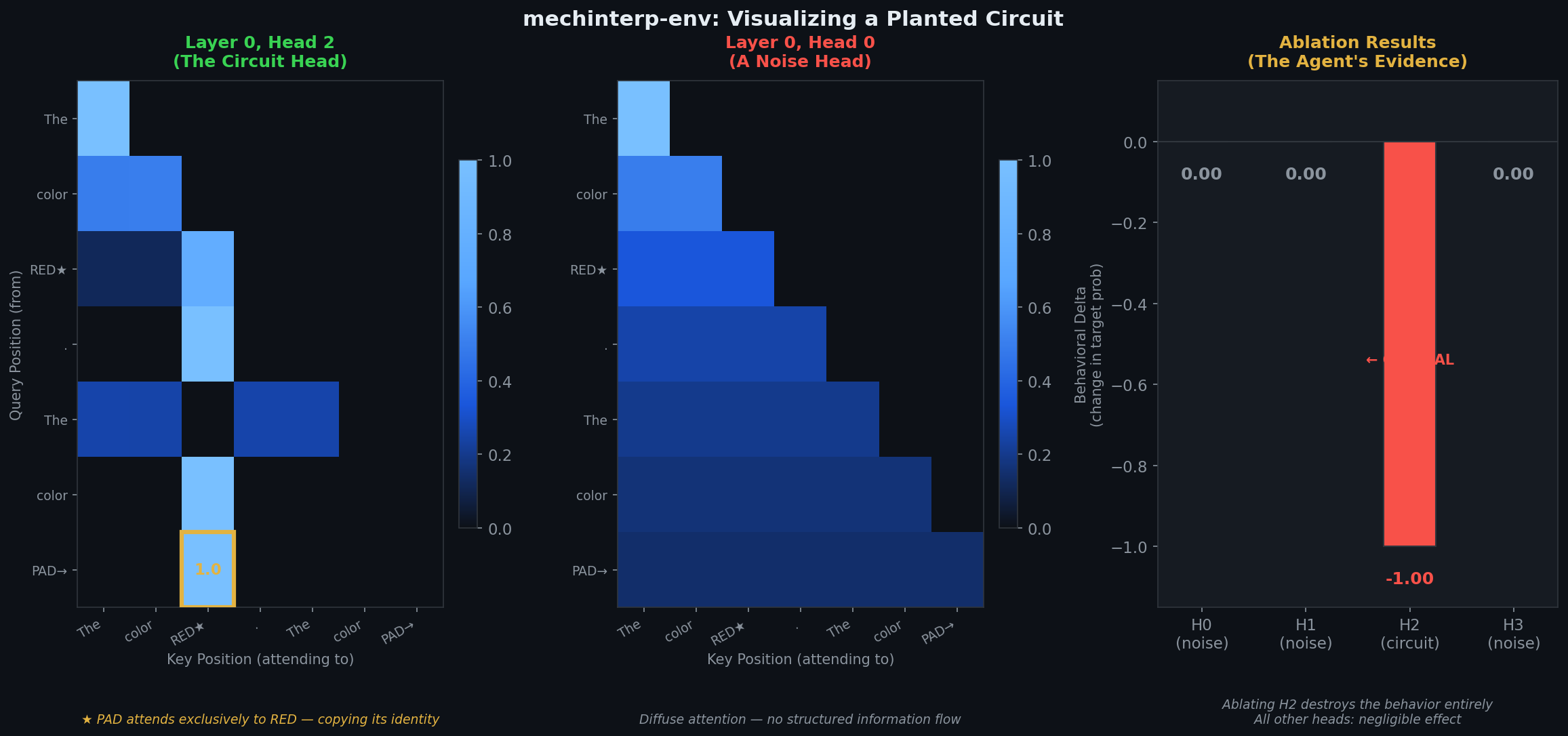
Left: The circuit head (H2) concentrates all attention on the RED token — copying it perfectly. Middle: A noise head spreads attention uniformly — no structured information flow. Right: The ablation evidence an agent uses to identify the circuit — ablating H2 causes a -1.0 behavioral collapse. Ablating noise heads: zero effect.
How It Works
                    THE SURGICAL LOOP
                    ─────────────────

[reset(task_id)]
      │
      ▼
Agent receives:
  • target_behavior  — "This head copies a token. Find it."
  • available_actions — ablate_head, patch_activation, query_logit_lens...
  • prerun_results   — (Task 1 only) ablation results already computed
      │
      ▼
[Agent Action: ablate_head(layer=0, head=2)]
      │
      ▼
Environment runs forward pass with H2 zeroed out
      │
      ▼
[Observation returned]:
  • behavioral_delta: -1.0000  ← H2 is CRITICAL
  • baseline_prob:     0.9999
  • ablated_prob:      0.0000
  • interpretation:   "IMPORTANT — likely circuit component"
      │
      ▼
[Reward: +0.40]  ← Information gain: |delta| × 0.3 + high-delta bonus
      │
      ▼
Agent ablates more heads, finds delta ≈ 0.0 for all others
      │
      ▼
[Agent Action: submit_hypothesis({"(0, 2)": 1.0})]
      │
      ▼
[Grader: F1 against ground truth] → score=0.999
[END] success=true steps=1 score=0.999
The Three Planted Circuits
Each task uses a different transformer model with a mathematically designed circuit. Ground truth is known by construction — we built the weights.
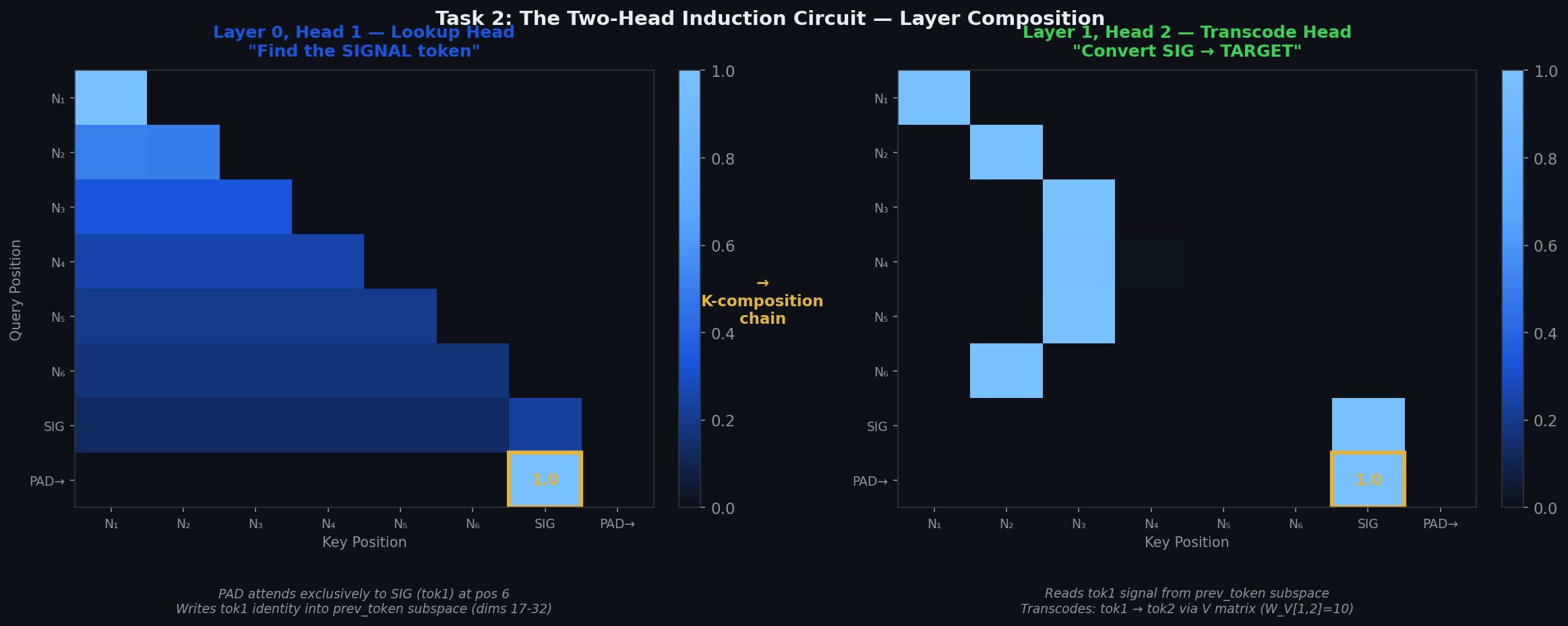
Task 2's two-head induction circuit: L0H1 (lookup head) concentrates attention on the signal token, writes its identity into dims 17-32. L1H2 (transcode head) reads that signal via K-composition and converts it to the target token. Ablating either head collapses the behavior entirely.
Task 1 — Copy Head (Easy)
Task 2 — Induction Circuit (Medium)
Task 3 — Committee Circuit (Hard)
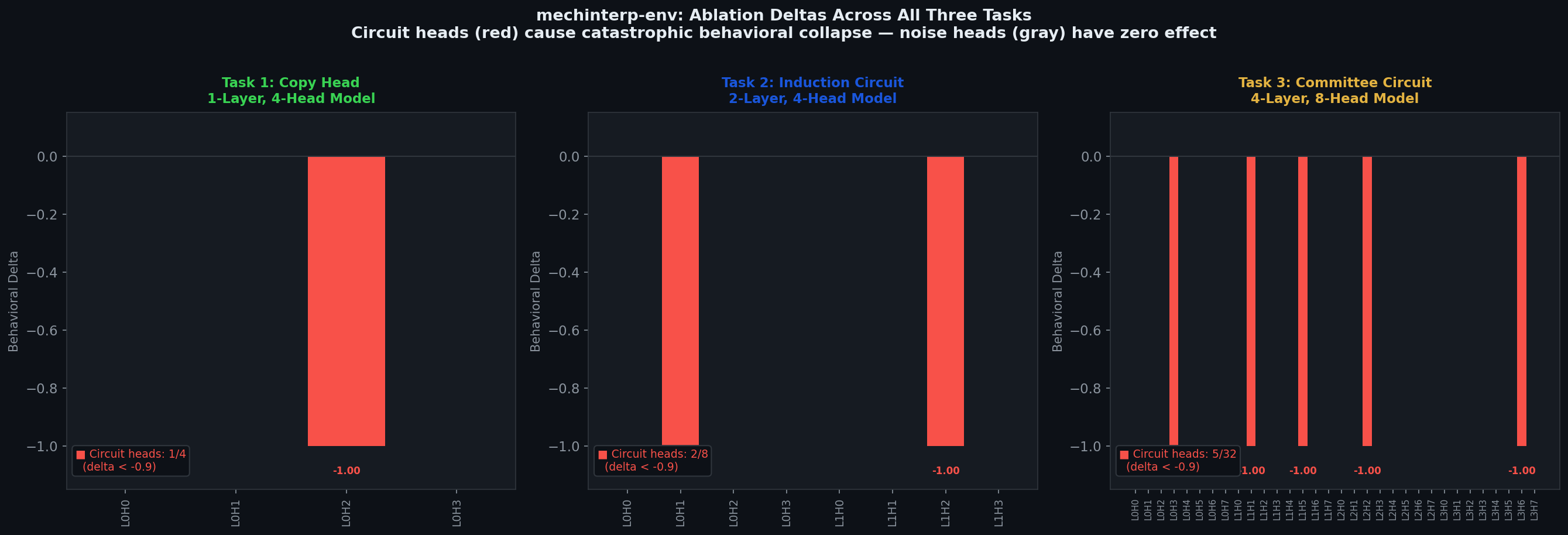
Ablation deltas across all three tasks. Circuit heads (red) cause catastrophic behavioral collapse when removed. Noise heads (gray) have exactly zero effect. The signal is clean — this is what real MI research looks like.
Reward Function
Dense reward — the agent gets signal at every step, not just at the end.
Step-level rewards
Terminal reward (on submit_hypothesis)
Calibration: Random agent ≈ 0.05 avg reward. Systematic agent ≈ 0.35. Agent understanding MI workflow ≈ 0.75+.
Frontier Model Baselines
Tested with Qwen/Qwen2.5-72B-Instruct via the HF inference router:
The difficulty progression is genuine. Hard tasks are actually hard.
Action Space
Grading
All graders are deterministic — no LLM, no randomness. Same hypothesis always gets the same score.
Why Toy Transformers?
This is how mechanistic interpretability research actually bootstraps. Elhage et al. (2021), Olsson et al. (2022), Wang et al. (2022) — all foundational MI papers start with toy models where ground truth is provable by construction.
Advantages over cached GPT-2 activations:
- ✅ Ground truth is mathematically exact — not approximate
- ✅ No GPU, no PyTorch, no TransformerLens — pure numpy
- ✅ Docker image is tiny — no 500MB activation cache files
- ✅ Microsecond forward passes — well within 20-minute budget
- ✅ Perfect determinism — same input always gives same score
Real-World Utility
MI circuit discovery is bottlenecked by researcher time. A senior MI researcher spends days to weeks localizing a single circuit. An RL agent trained on this environment is a step toward automating that — a research assistant that can run activation patching experiments, form hypotheses, and narrow down circuit components autonomously.
This environment serves as a curriculum: start with provably correct ground truth on toy models, then scale to real models with activation caches. The architecture already supports this.
The target community: Anthropic, DeepMind, EleutherAI, and every independent MI researcher would have direct use for an agent trained on this environment.
Setup
Quick start
git clone https://github.com/ChoudharyDeven/mechinterp-env
cd mechinterp-env
pip install numpy fastapi uvicorn pydantic httpx openai
python verify_tasks.py        # 46/46 checks passed
uvicorn server.app:app --host 0.0.0.0 --port 7860
Test it
curl http://localhost:7860/health
curl -X POST http://localhost:7860/reset \
     -H "Content-Type: application/json" \
     -d '{"task_id": "head-identification"}'
Docker
docker build -t mechinterp-env .
docker run -p 7860:7860 mechinterp-env
Run inference
export MECHINTERP_ENV_URL=https://potatochoudhary-mechinterp-env.hf.space
export HF_TOKEN=your_hf_token
export API_BASE_URL=https://router.huggingface.co/v1
export MODEL_NAME=Qwen/Qwen2.5-72B-Instruct
python inference.py
Environment Variables
Project Structure
mechinterp-env/
├── inference.py              ← Baseline inference script (mandatory)
├── openenv.yaml              ← OpenEnv manifest
├── models.py                 ← Pydantic types: Action, Observation, CircuitMask
├── client.py                 ← Python client (async + sync)
├── verify_tasks.py           ← 46-check verification script
├── Dockerfile
├── server/
│   ├── app.py                ← FastAPI: /reset /step /state /health
│   ├── environment.py        ← Core logic: reset(), step(), action handlers
│   ├── transformer.py        ← Numpy transformer engine
│   ├── tasks.py              ← Task definitions + ground truth circuits
│   ├── graders.py            ← Deterministic graders (no LLM)
│   └── rewards.py            ← Dense reward function
└── data/
    ├── models/
    │   ├── model_1layer.py   ← 1L copy head (d=64)
    │   ├── model_2layer.py   ← 2L induction circuit (d=64)
    │   └── model_4layer.py   ← 4L committee circuit (d=64)
    └── circuits/
        ├── circuit_1.json    ← {"(0, 2)": 1.0}
        ├── circuit_2.json    ← {"(0, 1)": 0.6, "(1, 2)": 1.0}
        └── circuit_3.json    ← 5-head ground truth
OpenEnv Spec Compliance
- ✅ Typed
Action,ObservationPydantic models - ✅
step(action)→(observation, reward, done, info) - ✅
reset()→ initial observation - ✅
state()→ current state - ✅
openenv.yamlwith 3 tasks and grader definitions - ✅ Passes
openenv validate - ✅ Docker build clean, port 7860
- ✅ Phase 1 + Phase 2 passed
References
- Elhage et al. (2021) — A Mathematical Framework for Transformer Circuits
- Olsson et al. (2022) — In-context Learning and Induction Heads
- Wang et al. (2022) — Interpretability in the Wild: a Circuit for Indirect Object Identification in GPT-2 small
- Conmy et al. (2023) — Towards Automated Circuit Discovery for Mechanistic Interpretability
License
MIT