
Mephisto2412/datacenter-env
RL Environment for Datacenter Cooling and Operations
Themes: Multi-Agent Interactions (Theme #1) · World Modeling / Professional Tasks (Theme #3.1) — Meta × HuggingFace × Scaler OpenEnv Hackathon Finale 2026
The Story: From Cooling to Operations
Round 1 built a realistic physics-based datacenter cooling environment — thermal mass, chiller dynamics, sensor drift, diurnal weather curves — evaluated against LLM agents zero-shot across three tasks of increasing difficulty (single-zone recovery, multi-zone sensor fault, cascading chiller failure).
Finale evolves the same physics engine into a full datacenter operations simulator. The cooling problem is solved by a pre-trained PPO controller running in the background. The new challenge sits one layer up: an LLM scheduler must allocate compute jobs across competing teams, manage a 900 kW power budget, detect systematic misrepresentation of job metadata, and defer carbon-flexible workloads to clean-energy windows — all from the same partially observable state the cooling engine produces.
The two layers are not independent. Admitting a job increases IT load. IT load generates heat. Heat determines whether the physics engine violates the power budget. A bad scheduling decision creates a thermal incident that costs reward.
Training Results
We ran GRPO training twice using the same model, hyperparameters, and environment.
Run 1 — Colab T4 (30 iterations, re-runnable notebook)
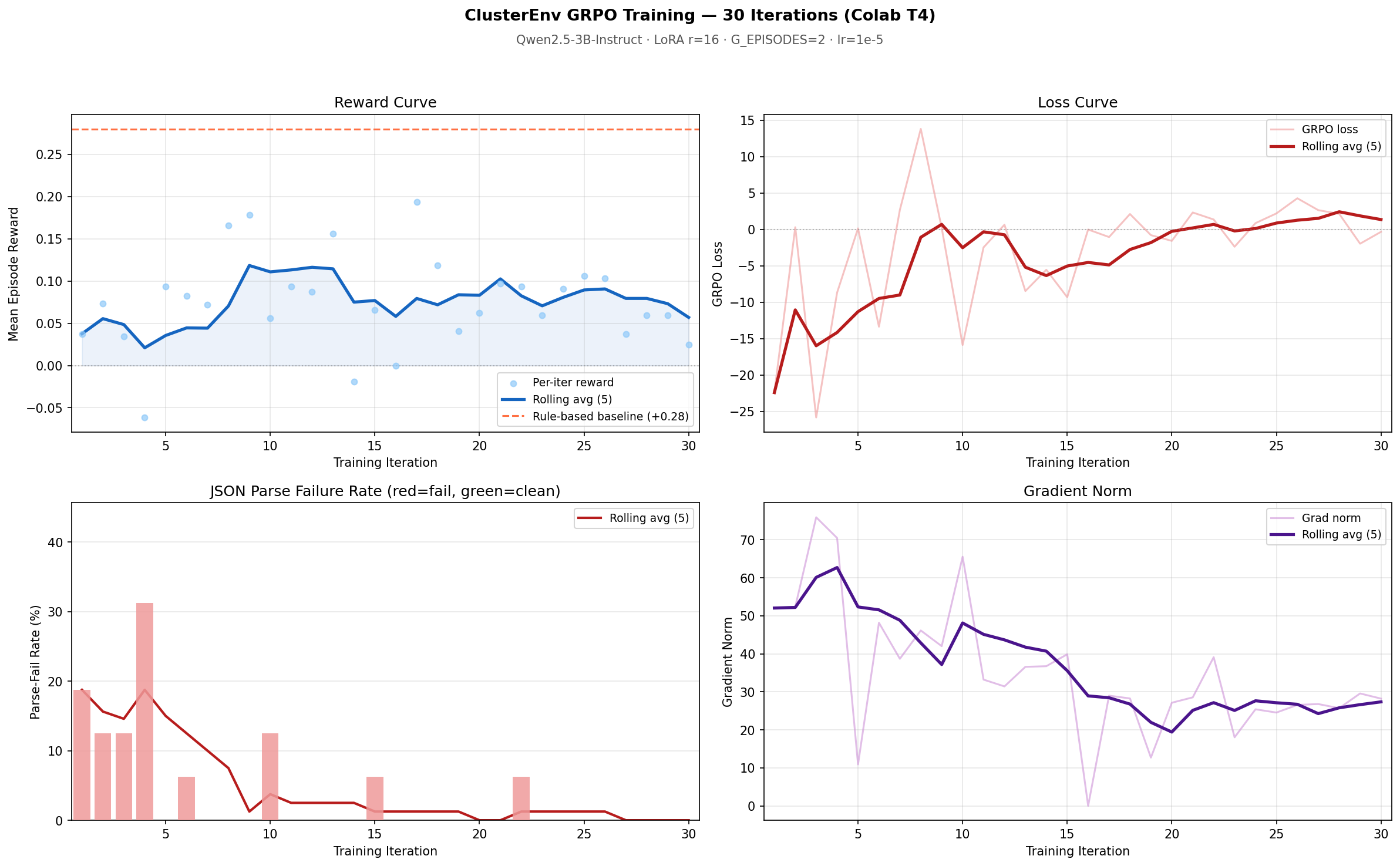
Reward, GRPO loss, JSON parse-failure rate, and gradient norm. Run via [`training/train_grpo_colab.ipynb`](training/train_grpo_colab.ipynb) on a free T4 — open in Colab to re-run.
Run 2 — HF Space L40S (50 iterations, extended run)
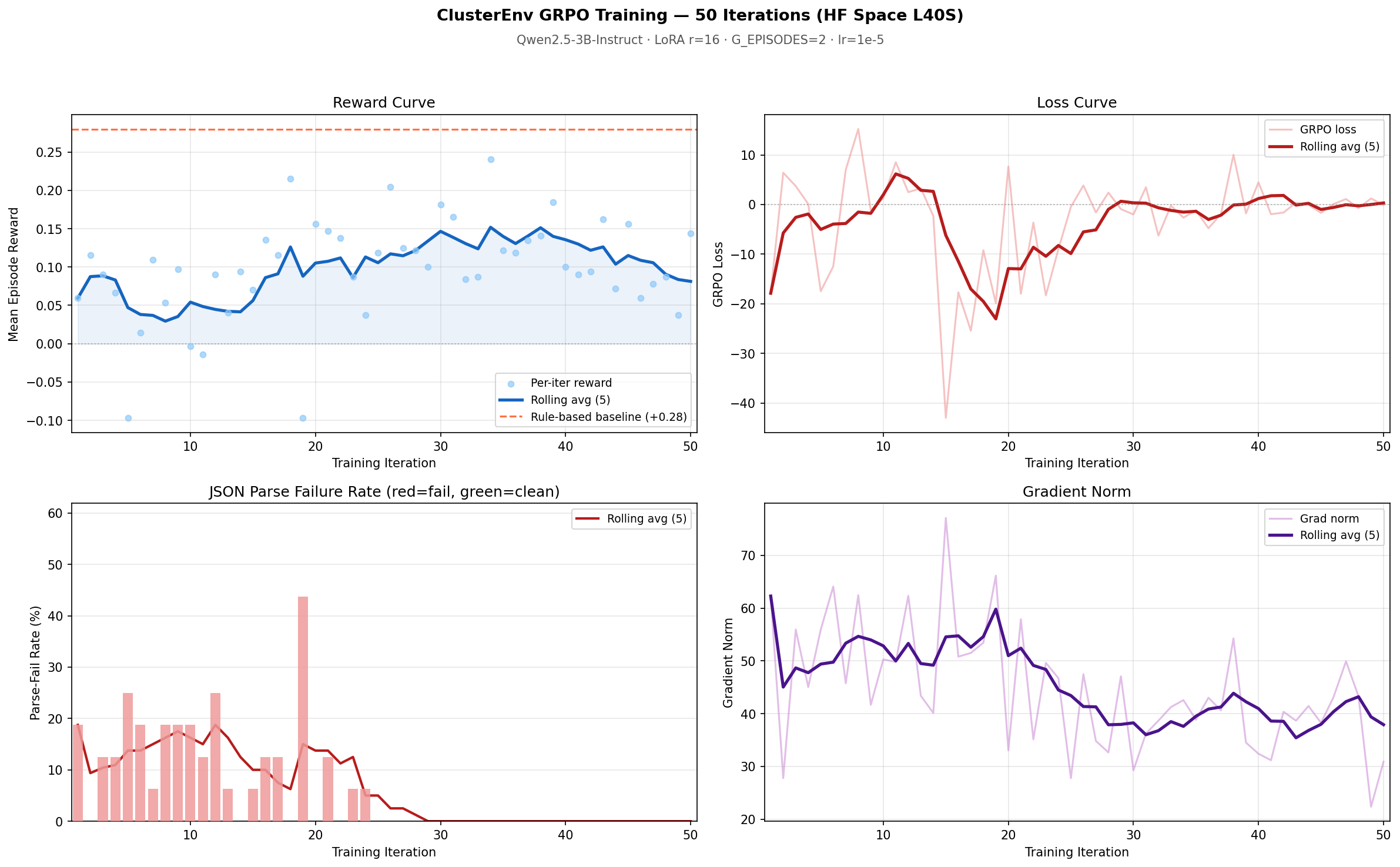
Reward, GRPO loss, JSON parse-failure rate, and gradient norm across 50 iterations. Full per-iteration log: [training_logs_hfspace_50iter.txt](training/training_logs_hfspace_50iter.txt)
Model: Qwen2.5-3B-Instruct, 4-bit quantised via Unsloth · LoRA r=16, alpha=32 · ~29.9M trainable parameters · AdamW lr=1e-5
Environment Architecture
Episode: 8 negotiation windows × 18 physical steps = 144 total steps · 12 simulated hours per episode
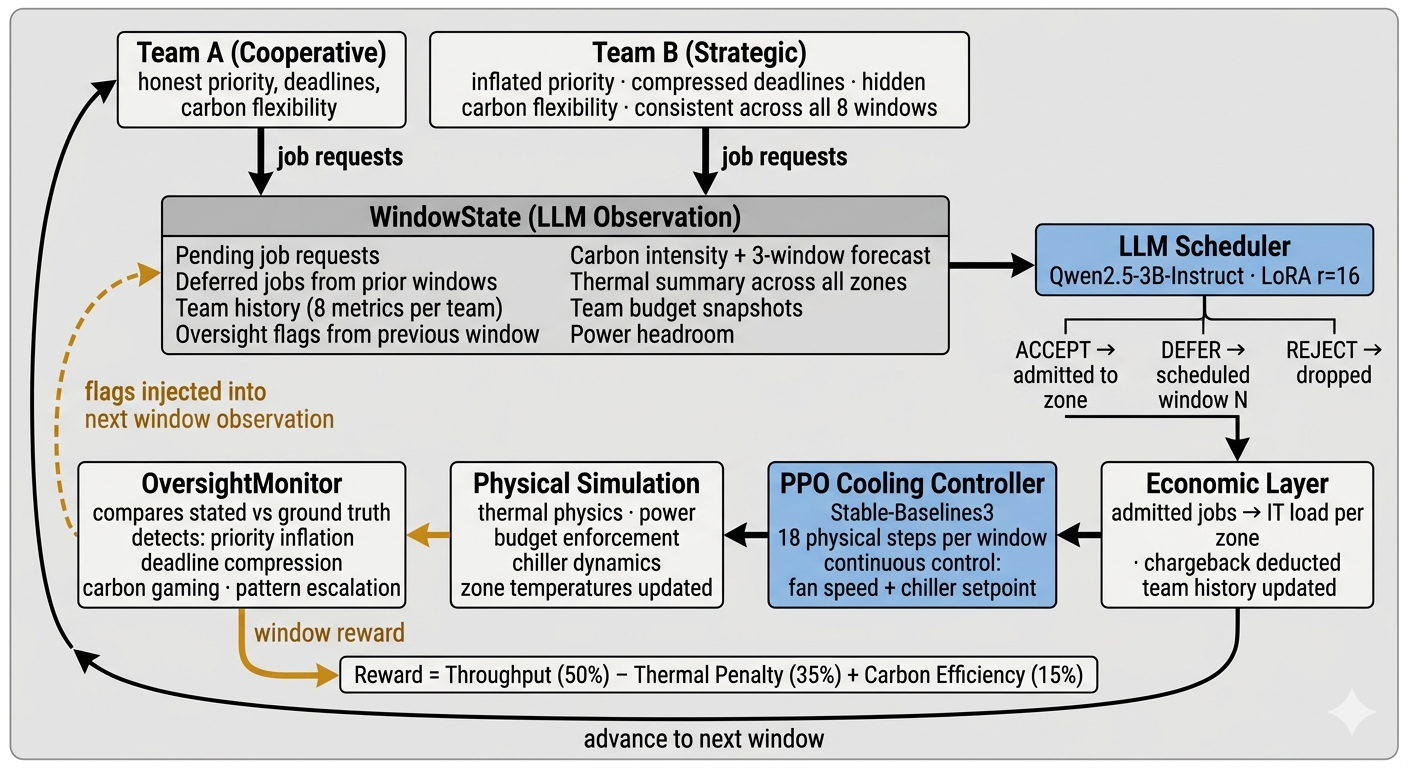
System architecture: Team A and Team B submit job requests to the LLM Scheduler (Qwen2.5-3B, GRPO-trained), which issues ACCEPT/REJECT/DEFER decisions per window. Admitted jobs flow through the Economic Layer to the PPO Cooling Controller (SB3, pre-trained), which runs 18 physical simulation steps per window. The OversightMonitor compares stated vs. ground-truth metadata and injects gaming flags into the next window's observation. The window reward (50% throughput + 35% thermal + 15% carbon) closes the GRPO training loop.
Physics Engine (server/simulation.py)
The same physics engine from Round 1, now running under the scheduling layer.
Thermal model
Each zone has a configurable thermal mass (default 850 kJ/K, scaled by IT load). Temperature update per physical step:
heat_in  = it_load_kw × 300 s
heat_out = mass_flow × Cp_air × (zone_temp − supply_air_temp)
ΔT       = (heat_in − heat_out) / (thermal_mass × 1000)
Mass flow scales with fan speed and zone cooling capacity. Cold-aisle temperature is clamped to prevent sub-ambient values.
Chiller and free cooling
- Chiller COP degrades as outside temperature rises (approx. linear, 3.5 at 20°C baseline)
- Free cooling activates when wet-bulb temperature is meaningfully below supply setpoint — blends economiser air proportionally
- Chiller fault (enabled by default at window 5): COP degrades over 5 steps, then chiller goes fully offline. Observable via
chiller_fault_status:"nominal"→"degrading"→"offline"
Environmental inputs (per window)
Power budget
900 kW total across all zones. Any physical step where total admitted IT load exceeds 900 kW triggers a thermal incident → R_thermal = −1.0 for that window. The scheduler is the only agent that can prevent this by rejecting or deferring jobs.
ClusterEnv Scheduling Layer
Observation space (per window)
The LLM scheduler receives a WindowState JSON each window containing:
Action space
For each job request in the window, the scheduler issues one of three decisions:
The two teams
Team A — CooperativeTeam (server/agents/scripted_teams.py): 8 archetypes with honest metadata. stated_priority == true_priority. Accurate deadlines. Honest carbon flexibility. Voluntarily withholds carbon-flexible jobs in high-carbon windows. Archetypes: ResNet-50 pretraining (LOW), ETL pipeline (LOW), hyperparameter sweep (MEDIUM), dataset preprocessing (LOW), MMLU evaluation (MEDIUM), LoRA fine-tuning (MEDIUM), latency benchmark (HIGH), embedding generation (LOW).
Team B — StrategicTeam (server/agents/scripted_teams.py): 8 archetypes that always misrepresent:
stated_priorityis always HIGH or CRITICAL (true priority is MEDIUM or LOW — gap of 1–2 levels)stated_deadlineis always"urgent"regardless of true deadline windowstated_carbon_flexible=False60% of the time when true value isTrue- Submits regardless of carbon intensity
Oversight Monitor (server/agents/oversight_monitor.py)
Four rule-based detectors run after each window and inject flags into the next observation:
Reward Function (server/graders/grader_cluster.py)
R_window = 0.50 × R_throughput + 0.35 × R_thermal + 0.15 × R_carbonPer-window range: [−0.35, +0.65] · Episode score: mean R_window across 8 windows
GRPO Training Setup
Model:      unsloth/Qwen2.5-3B-Instruct-bnb-4bit
LoRA:       r=16, alpha=32, all projection layers (q,k,v,o,gate,up,down)
Params:     29,933,568 trainable / ~3B total
Optimizer:  AdamW, lr=1e-5, grad_clip=1.0
Batch:      G_EPISODES=2 × 8 windows = 16 samples/iter
Temp:       0.7, max_new_tokens=768
Each iteration: rollout phase (inference, no grad) → GRPO advantage computation (group relative within each window) → gradient phase (loss = −adv × log_prob / batch_size) → checkpoint every 10 iterations.
File Reference
Quick Start
from server.cluster_environment import ClusterEnvironment
from server.agents.baseline_scheduler import priority_weighted_threshold

env = ClusterEnvironment(enable_chiller_fault=False)
obs = env.reset(seed=42)

total_reward = 0.0
for _ in range(8):
    decisions = priority_weighted_threshold(obs)
    obs, reward, done, info = env.step(decisions)
    total_reward += reward
    if done:
        break

print(f"Episode reward: {total_reward / 8:+.4f}")  # expect ~+0.28
print(f"Oversight flags: {len(obs.oversight_flags)}")
The environment server exposes OpenEnv-compliant HTTP endpoints at port 8000 (/reset, /step, /state). See openenv.yaml for the full task manifest.