
JetLaggedByData/scifi-forge
<div align="center">
🚀 SciFi Forge
Multi-Agent Science Fiction Story Generation Pipeline
How a Deep Learning coursework LSTM became a production-grade agentic AI system
   
</div>
📖 Project Overview
SciFi Forge is a three-generation AI evolution project — from a character-level LSTM trained on a 149M-character science fiction corpus, to a QLoRA fine-tuned LLM, to a fully agentic LangGraph pipeline with four specialised collaborating agents.
The project demonstrates the entire ML engineering lifecycle: data pipeline, model training, evaluation, agent orchestration, memory systems, experiment tracking, and production deployment. All tools are 100% free and everything runs on a single 8GB GPU.
🎬 Demo
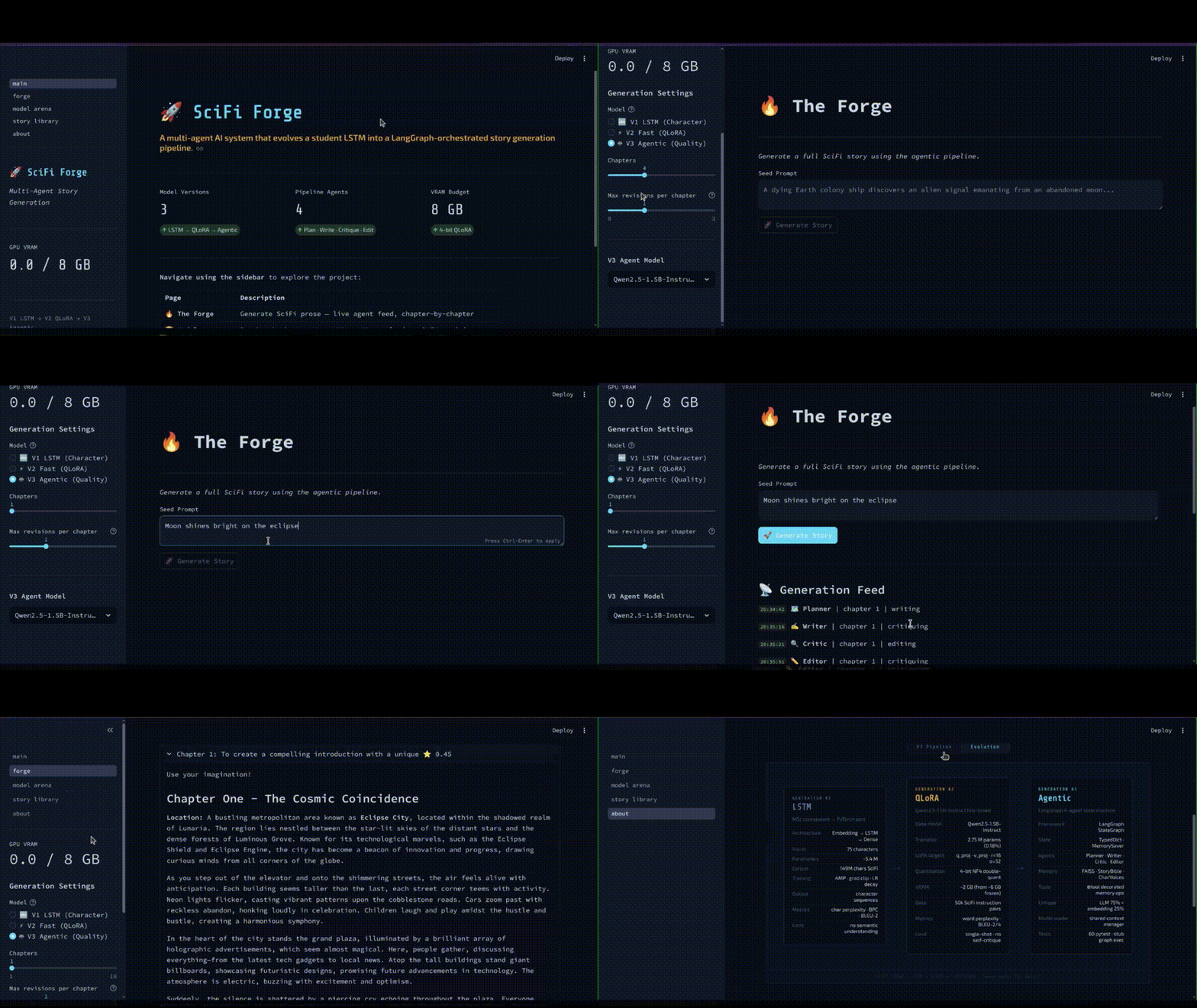
Live interactive app (Qwen2.5-0.5B, CPU): → huggingface.co/spaces/JetLaggedByData/scifi-forge
🏗️ Architecture
Three-Generation Evolution
V1: LSTM (MSc coursework)          V2: QLoRA LLM (self-directed)       V3: Agentic (portfolio)
─────────────────────────          ──────────────────────────────       ──────────────────────
TensorFlow / Keras                 Qwen2.5-1.5B-Instruct                LangGraph state machine
Char-level, 75 vocab               4-bit QLoRA via bitsandbytes          4 specialised agents
Embedding→LSTM(1024)→Dense         50k instruction samples               FAISS chapter memory
149M char SciFi corpus             8GB GPU, 3 epochs                     MLflow tracking
Google Colab                       ~60% perplexity reduction             Critic-gated revision
V3 Multi-Agent Pipeline
flowchart TD
    A([🚀 Seed Prompt]) --> B

    B["🗺️ Planner
    Generates story bible
    title · acts · characters · world rules"]
    B --> C

    C["✍️ Writer
    Retrieves FAISS context
    Generates ~600 word chapter"]
    C --> D

    D{"🔍 Critic
    consistency · style · coherence
    scored 0–1 each"}

    D -->|"score < 0.6 AND revisions remaining"| E
    D -->|"score ≥ 0.6 OR budget exhausted"| F

    E["✏️ Editor
    Rewrites chapter
    per revision instructions"]
    E --> D

    F["⏭️ Advance Chapter
    reset critique · increment counter"]
    F -->|more chapters| C
    F -->|done| G

    G([📄 story.json])

    style A fill:#e8f4f8,stroke:#2196F3,color:#1a1a2e
    style B fill:#e3f2fd,stroke:#1976D2,color:#1a1a2e
    style C fill:#fff8e1,stroke:#F57F17,color:#1a1a2e
    style D fill:#e8eaf6,stroke:#3949AB,color:#1a1a2e
    style E fill:#fff3e0,stroke:#E65100,color:#1a1a2e
    style F fill:#f3e5f5,stroke:#7B1FA2,color:#1a1a2e
    style G fill:#e8f5e9,stroke:#2E7D32,color:#1a1a2e
Memory System
┌─────────────────────────────────────────────────────────┐
│                    MEMORY SYSTEM                         │
│                                                          │
│  StoryBible (JSON)              ChapterMemory (FAISS)    │
│  ─────────────────              ──────────────────────   │
│  Planner writes once            Writer adds each chapter │
│  All agents read                Semantic retrieval       │
│  ~500 token summary             all-MiniLM-L6-v2 (CPU)  │
│  data/stories/<id>/bible.json   50% sentence overlap     │
└─────────────────────────────────────────────────────────┘
📊 Benchmark Results
V1 and V2 perplexity are on different scales (character-level vs word-level) and are not directly comparable. V3 critique scores are computed by the Critic agent: 75% LLM scoring + 25% embedding-based voice consistency. V3 scores improve with more chapters — each chapter adds to the FAISS memory, giving the Writer and Critic richer context for consistency scoring. The figures above are based on single-chapter stories; multi-chapter runs yield progressively stronger coherence signals.
📁 Project Structure
scifi-forge/
│
├── v1_baseline/                    # LSTM baseline — preserved as benchmark anchor
│   ├── lstm_model.py               # Embedding → LSTM(1024) → Dense
│   ├── train.py                    # Original training config (unchanged)
│   ├── generate.py                 # Character-level generation
│   └── evaluate.py                 # Perplexity, BLEU-2, inference speed
│
├── v2_finetuned/                   # QLoRA fine-tuned Qwen2.5-1.5B
│   ├── finetune.py                 # 4-bit QLoRA training (8GB VRAM safe)
│   ├── generate.py                 # Inference with LoRA adapters
│   ├── evaluate.py                 # Word-level metrics, genre score
│   └── adapters/                   # LoRA weights (gitignored — push to HF Hub)
│
├── v3_agentic/                     # 🌟 Main deliverable — agentic pipeline
│   ├── agents/
│   │   ├── planner.py              # Story bible JSON generation
│   │   ├── writer.py               # Chapter generation + FAISS retrieval
│   │   ├── critic.py               # 3-dimension scoring + MLflow logging
│   │   └── editor.py               # Revision with Critic feedback
│   ├── memory/
│   │   ├── story_bible.py          # Persistent JSON + token-capped summary
│   │   └── chapter_store.py        # FAISS semantic chapter memory (CPU)
│   ├── pipeline/
│   │   ├── state.py                # StoryState TypedDict
│   │   ├── graph.py                # LangGraph with conditional routing
│   │   └── runner.py               # CLI + streaming entry point
│   └── evaluate/
│       ├── benchmark.py            # Full V1 vs V2 vs V3 report
│       └── consistency_scorer.py   # Story-level metrics from stored JSONs
│
├── data/
│   ├── raw/                        # internet_archive_scifi_v3.txt (gitignored)
│   ├── chunks/                     # Instruction-format JSONL (gitignored)
│   └── stories/                    # Pre-generated stories (COMMITTED)
│       ├── story_01/story.json
│       └── ...
│
├── app/
│   ├── main.py                     # Unified entry point (auto-detects CPU/GPU)
│   └── pages/
│       ├── 1_forge.py              # Live generation with agent feed
│       ├── 2_model_arena.py        # Benchmark charts
│       ├── 3_story_library.py      # Browse pre-generated stories
│       └── 4_about.py             # Project timeline + architecture
│
├── mlflow_runs/
│   ├── benchmark_report.json       # Full metrics (COMMITTED)
│   ├── charts/                     # Pre-exported Plotly JSON (COMMITTED)
│   └── export_charts.py            # Regenerate charts from benchmark report
│
├── scripts/
│   └── pregenerate_stories.py      # Generate 5 seed stories before deployment
│
├── tests/                          # pytest suite
├── Dockerfile                      # CPU image for HF Spaces / Docker
├── docker-compose.yml              # Local dev (lite + full + mlflow)
├── requirements.txt
└── README.md                       # You are here
⚡ Quickstart
Prerequisites
- Ubuntu Linux (tested), Python 3.10+
- GPU with 8GB VRAM + CUDA (for V2 fine-tuning and V3 full pipeline)
- CPU-only mode works for the lite app and pre-generated story browsing
1. Clone and install
git clone https://github.com/JetLaggedByData/LanguageModel.git
cd scifi-forge

python3.10 -m venv .venv && source .venv/bin/activate

# Install PyTorch with CUDA (check your CUDA version: nvcc --version)
pip install torch torchvision torchaudio --index-url https://download.pytorch.org/whl/cu121

pip install -r requirements.txt
python -m spacy download en_core_web_sm
python -c "import nltk; nltk.download('punkt')"
2. Download the corpus
mkdir -p data/raw
# Download internet_archive_scifi_v3.txt (~149MB) to data/raw/
# Source: https://archive.org/details/SciFiStories
3. Run V1 baseline
# Train (optional — checkpoint already committed if using pre-trained weights)
python v1_baseline/train.py

# Generate
python v1_baseline/generate.py

# Evaluate
python v1_baseline/evaluate.py
4. Prepare data and fine-tune V2
# Prepare 50k instruction-format samples (~5–10 min)
python data/prepare_dataset.py
python data/verify_dataset.py

# Fine-tune (~4–6h on 8GB GPU, 3 epochs)
python v2_finetuned/finetune.py

# Test generation
python v2_finetuned/generate.py

# Evaluate
python v2_finetuned/evaluate.py
5. Run V3 agentic pipeline
cd v3_agentic

# Single story (CLI)
python pipeline/runner.py \
  --prompt "A dying colony ship discovers an alien signal" \
  --chapters 4 \
  --revisions 2

# Pre-generate 5 stories + export benchmark charts (~2–3h)
python ../scripts/pregenerate_stories.py

# Quick smoke test (1 chapter per story, ~15 min)
python ../scripts/pregenerate_stories.py --dry-run
6. Launch the app
# Full local app (requires GPU + trained adapters)
streamlit run app/main.py

# Lite app (CPU-safe, mirrors HF Spaces deployment)
LITE_MODE=1 streamlit run app/main.py
7. Run benchmarks
python v3_agentic/evaluate/benchmark.py
python mlflow_runs/export_charts.py

# View MLflow runs
mlflow ui --backend-store-uri mlflow_runs/
🛠️ Tech Stack
Hardware: 8GB GPU VRAM · 32GB CPU RAM · Ubuntu Linux Cost: £0 — 100% free tools and hosting
🔑 Key Design Decisions
VRAM management — all fine-tuning uses 4-bit QLoRA (nf4, double quantisation, bfloat16 compute) with per_device_train_batch_size=1, gradient_checkpointing=True, and paged_adamw_8bit. Peak VRAM stays under 6GB, leaving 2GB headroom on an 8GB card.
Agent model sharing — all four V3 agents share the same model, loaded once per run via a context manager (user-selectable; default: Qwen2.5-1.5B + LoRA adapters). Temperature varies by role: Planner (0.4, structured JSON), Writer (0.75, creative prose), Critic (0.2, deterministic scoring), Editor (0.65, tight revision).
Graceful degradation — every agent wraps generation in try/except and returns a minimal valid state on failure. The pipeline never hard-crashes; it logs the error to state["error"] and continues, so a single bad chapter doesn't abort a 6-chapter story.
Deployment split — full V3 runs locally on GPU and is screen-recorded for the demo video. HF Spaces runs the lite app (user-selectable CPU models, default Qwen2.5-0.5B) with pre-generated stories and pre-exported charts committed to the repo, so the deployed app looks rich without any GPU inference at runtime.
🧪 Running Tests
pytest tests/ -v
pytest tests/ -v --cov=v3_agentic --cov-report=term-missing
🚀 Deployment
# Build and test Docker image locally
docker build -t scifi-forge .
docker run -p 7860:7860 scifi-forge

# Deploy to HF Spaces (GitHub Actions handles this automatically on push to main)
git push origin main
See .github/workflows/deploy.yml for the full CI/CD pipeline.
📄 License
MIT — see LICENSE
<div align="center">
Built with ☕ on 8GB VRAM · Ubuntu Linux · 100% free tools
</div>