
htsn/lung_nodule_ct_detection
0
1# Model Overview2A pre-trained model for volumetric (3D) detection of the lung nodule from CT image.3 4This model is trained on LUNA16 dataset (https://luna16.grand-challenge.org/Home/), using the RetinaNet (Lin, Tsung-Yi, et al. "Focal loss for dense object detection." ICCV 2017. https://arxiv.org/abs/1708.02002).5 6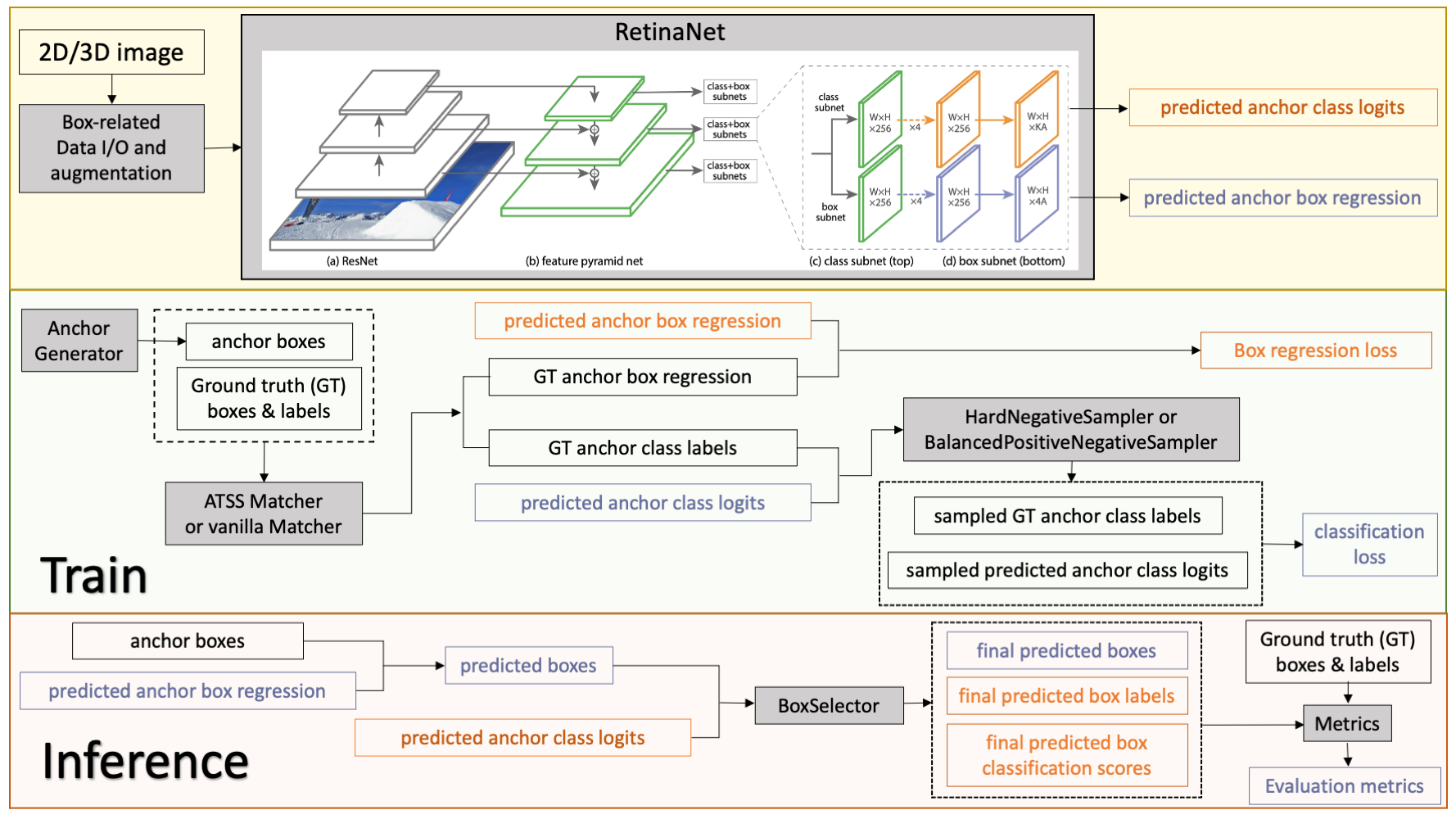7 8## Data9The dataset we are experimenting in this example is LUNA16 (https://luna16.grand-challenge.org/Home/), which is based on [LIDC-IDRI database](https://wiki.cancerimagingarchive.net/display/Public/LIDC-IDRI) [3,4,5].10 11LUNA16 is a public dataset of CT lung nodule detection. Using raw CT scans, the goal is to identify locations of possible nodules, and to assign a probability for being a nodule to each location.12 13Disclaimer: We are not the host of the data. Please make sure to read the requirements and usage policies of the data and give credit to the authors of the dataset! We acknowledge the National Cancer Institute and the Foundation for the National Institutes of Health, and their critical role in the creation of the free publicly available LIDC/IDRI Database used in this study.14 15### 10-fold data splitting16We follow the official 10-fold data splitting from LUNA16 challenge and generate data split json files using the script from [nnDetection](https://github.com/MIC-DKFZ/nnDetection/blob/main/projects/Task016_Luna/scripts/prepare.py).17 18Please download the resulted json files from https://github.com/Project-MONAI/MONAI-extra-test-data/releases/download/0.8.1/LUNA16_datasplit-20220615T233840Z-001.zip.19 20In these files, the values of "box" are the ground truth boxes in world coordinate.21 22### Data resampling23The raw CT images in LUNA16 have various of voxel sizes. The first step is to resample them to the same voxel size.24In this model, we resampled them into 0.703125 x 0.703125 x 1.25 mm.25 26Please following the instruction in Section 3.1 of https://github.com/Project-MONAI/tutorials/tree/main/detection to do the resampling.27 28### Data download29The mhd/raw original data can be downloaded from [LUNA16](https://luna16.grand-challenge.org/Home/). The DICOM original data can be downloaded from [LIDC-IDRI database](https://wiki.cancerimagingarchive.net/display/Public/LIDC-IDRI) [3,4,5]. You will need to resample the original data to start training.30 31Alternatively, we provide [resampled nifti images](https://drive.google.com/drive/folders/1JozrufA1VIZWJIc5A1EMV3J4CNCYovKK?usp=share_link) and a copy of [original mhd/raw images](https://drive.google.com/drive/folders/1-enN4eNEnKmjltevKg3W2V-Aj0nriQWE?usp=share_link) from [LUNA16](https://luna16.grand-challenge.org/Home/) for users to download.32 33## Training configuration34The training was performed with the following:35 36- GPU: at least 16GB GPU memory, requires 32G when exporting TRT model37- Actual Model Input: 192 x 192 x 8038- AMP: True39- Optimizer: Adam40- Learning Rate: 1e-241- Loss: BCE loss and L1 loss42 43### Input441 channel45- List of 3D CT patches46 47### Output48In Training Mode: A dictionary of classification and box regression loss.49 50In Evaluation Mode: A list of dictionaries of predicted box, classification label, and classification score.51 52## Performance53Coco metric is used for evaluating the performance of the model. The pre-trained model was trained and validated on data fold 0. This model achieves a mAP=0.852, mAR=0.998, AP(IoU=0.1)=0.858, AR(IoU=0.1)=1.0.54 55Please note that this bundle is non-deterministic because of the max pooling layer used in the network. Therefore, reproducing the training process may not get exactly the same performance.56Please refer to https://pytorch.org/docs/stable/notes/randomness.html#reproducibility for more details about reproducibility.57 58#### Training Loss5960 61#### Validation Accuracy62The validation accuracy in this curve is the mean of mAP, mAR, AP(IoU=0.1), and AR(IoU=0.1) in Coco metric.63 6465 66#### TensorRT speedup67The `lung_nodule_ct_detection` bundle supports acceleration with TensorRT through the ONNX-TensorRT method. The table below displays the speedup ratios observed on an A100 80G GPU. Please note that when using the TensorRT model for inference, the `force_sliding_window` parameter in the `inference.json` file must be set to `true`. This ensures that the bundle uses the `SlidingWindowInferer` during inference and maintains the input spatial size of the network. Otherwise, if given an input with spatial size less than the `infer_patch_size`, the input spatial size of the network would be changed.68 69| method | torch_fp32(ms) | torch_amp(ms) | trt_fp32(ms) | trt_fp16(ms) | speedup amp | speedup fp32 | speedup fp16 | amp vs fp16|70| :---: | :---: | :---: | :---: | :---: | :---: | :---: | :---: | :---: |71| model computation | 7449.84 | 996.08 | 976.67 | 626.90 | 7.63 | 7.63 | 11.88 | 1.56 |72| end2end | 36458.26 | 7259.35 | 6420.60 | 4698.34 | 5.02 | 5.68 | 7.76 | 1.55 |73 74Where:75- `model computation` means the speedup ratio of model's inference with a random input without preprocessing and postprocessing76- `end2end` means run the bundle end-to-end with the TensorRT based model.77- `torch_fp32` and `torch_amp` are for the PyTorch models with or without `amp` mode.78- `trt_fp32` and `trt_fp16` are for the TensorRT based models converted in corresponding precision.79- `speedup amp`, `speedup fp32` and `speedup fp16` are the speedup ratios of corresponding models versus the PyTorch float32 model80- `amp vs fp16` is the speedup ratio between the PyTorch amp model and the TensorRT float16 based model.81 82Currently, the only available method to accelerate this model is through ONNX-TensorRT. However, the Torch-TensorRT method is under development and will be available in the near future.83 84This result is benchmarked under:85 - TensorRT: 8.5.3+cuda11.886 - Torch-TensorRT Version: 1.4.087 - CPU Architecture: x86-6488 - OS: ubuntu 20.0489 - Python version:3.8.1090 - CUDA version: 12.091 - GPU models and configuration: A100 80G92 93## MONAI Bundle Commands94In addition to the Pythonic APIs, a few command line interfaces (CLI) are provided to interact with the bundle. The CLI supports flexible use cases, such as overriding configs at runtime and predefining arguments in a file.95 96For more details usage instructions, visit the [MONAI Bundle Configuration Page](https://docs.monai.io/en/latest/config_syntax.html).97 98#### Execute training:99 100```101python -m monai.bundle run --config_file configs/train.json102```103 104Please note that if the default dataset path is not modified with the actual path in the bundle config files, you can also override it by using `--dataset_dir`:105 106```107python -m monai.bundle run --config_file configs/train.json --dataset_dir <actual dataset path>108```109 110#### Override the `train` config to execute evaluation with the trained model:111 112```113python -m monai.bundle run --config_file "['configs/train.json','configs/evaluate.json']"114```115 116#### Execute inference on resampled LUNA16 images by setting `"whether_raw_luna16": false` in `inference.json`:117 118```119python -m monai.bundle run --config_file configs/inference.json120```121With the same command, we can execute inference on original LUNA16 images by setting `"whether_raw_luna16": true` in `inference.json`. Remember to also set `"data_list_file_path": "$@bundle_root + '/LUNA16_datasplit/mhd_original/dataset_fold0.json'"` and change `"dataset_dir"`.122 123Note that in inference.json, the transform "LoadImaged" in "preprocessing" and "AffineBoxToWorldCoordinated" in "postprocessing" has `"affine_lps_to_ras": true`.124This depends on the input images. LUNA16 needs `"affine_lps_to_ras": true`.125It is possible that your inference dataset should set `"affine_lps_to_ras": false`.126 127#### Export checkpoint to TensorRT based models with fp32 or fp16 precision128 129```bash130python -m monai.bundle trt_export --net_id network_def --filepath models/model_trt.ts --ckpt_file models/model.pt --meta_file configs/metadata.json --config_file configs/inference.json --precision <fp32/fp16> --input_shape "[1, 1, 512, 512, 192]" --use_onnx "True" --use_trace "True" --onnx_output_names "['output_0', 'output_1', 'output_2', 'output_3', 'output_4', 'output_5']" --network_def#use_list_output "True"131```132 133#### Execute inference with the TensorRT model134 135```136python -m monai.bundle run --config_file "['configs/inference.json', 'configs/inference_trt.json']"137```138 139# References140[1] Lin, Tsung-Yi, et al. "Focal loss for dense object detection." ICCV 2017. https://arxiv.org/abs/1708.02002)141 142[2] Baumgartner and Jaeger et al. "nnDetection: A self-configuring method for medical object detection." MICCAI 2021. https://arxiv.org/pdf/2106.00817.pdf143 144[3] Armato III, S. G., McLennan, G., Bidaut, L., McNitt-Gray, M. F., Meyer, C. R., Reeves, A. P., Zhao, B., Aberle, D. R., Henschke, C. I., Hoffman, E. A., Kazerooni, E. A., MacMahon, H., Van Beek, E. J. R., Yankelevitz, D., Biancardi, A. M., Bland, P. H., Brown, M. S., Engelmann, R. M., Laderach, G. E., Max, D., Pais, R. C. , Qing, D. P. Y. , Roberts, R. Y., Smith, A. R., Starkey, A., Batra, P., Caligiuri, P., Farooqi, A., Gladish, G. W., Jude, C. M., Munden, R. F., Petkovska, I., Quint, L. E., Schwartz, L. H., Sundaram, B., Dodd, L. E., Fenimore, C., Gur, D., Petrick, N., Freymann, J., Kirby, J., Hughes, B., Casteele, A. V., Gupte, S., Sallam, M., Heath, M. D., Kuhn, M. H., Dharaiya, E., Burns, R., Fryd, D. S., Salganicoff, M., Anand, V., Shreter, U., Vastagh, S., Croft, B. Y., Clarke, L. P. (2015). Data From LIDC-IDRI [Data set]. The Cancer Imaging Archive. https://doi.org/10.7937/K9/TCIA.2015.LO9QL9SX145 146[4] Armato SG 3rd, McLennan G, Bidaut L, McNitt-Gray MF, Meyer CR, Reeves AP, Zhao B, Aberle DR, Henschke CI, Hoffman EA, Kazerooni EA, MacMahon H, Van Beeke EJ, Yankelevitz D, Biancardi AM, Bland PH, Brown MS, Engelmann RM, Laderach GE, Max D, Pais RC, Qing DP, Roberts RY, Smith AR, Starkey A, Batrah P, Caligiuri P, Farooqi A, Gladish GW, Jude CM, Munden RF, Petkovska I, Quint LE, Schwartz LH, Sundaram B, Dodd LE, Fenimore C, Gur D, Petrick N, Freymann J, Kirby J, Hughes B, Casteele AV, Gupte S, Sallamm M, Heath MD, Kuhn MH, Dharaiya E, Burns R, Fryd DS, Salganicoff M, Anand V, Shreter U, Vastagh S, Croft BY. The Lung Image Database Consortium (LIDC) and Image Database Resource Initiative (IDRI): A completed reference database of lung nodules on CT scans. Medical Physics, 38: 915--931, 2011. DOI: https://doi.org/10.1118/1.3528204147 148[5] Clark, K., Vendt, B., Smith, K., Freymann, J., Kirby, J., Koppel, P., Moore, S., Phillips, S., Maffitt, D., Pringle, M., Tarbox, L., & Prior, F. (2013). The Cancer Imaging Archive (TCIA): Maintaining and Operating a Public Information Repository. Journal of Digital Imaging, 26(6), 1045–1057. https://doi.org/10.1007/s10278-013-9622-7149 150# License151Copyright (c) MONAI Consortium152 153Licensed under the Apache License, Version 2.0 (the "License");154you may not use this file except in compliance with the License.155You may obtain a copy of the License at156 157 http://www.apache.org/licenses/LICENSE-2.0158 159Unless required by applicable law or agreed to in writing, software160distributed under the License is distributed on an "AS IS" BASIS,161WITHOUT WARRANTIES OR CONDITIONS OF ANY KIND, either express or implied.162See the License for the specific language governing permissions and163limitations under the License.164